
Introduction
When an event is labeled “unforeseen,” it almost always was—only for those unwilling to see.
Organizations and decision-makers fail not because they are blind, but because they are trained to look elsewhere: at consolidated numbers, familiar certainties, and confirmations of existing direction.
My work begins before the crisis, in the uncomfortable zone where signals are ambiguous and do not yet justify visible action. Intelligence here does not deliver dramatic alerts; it builds selective attention. That attention is the difference between being surprised and being prepared.
Why Weak Signals Are Ignored
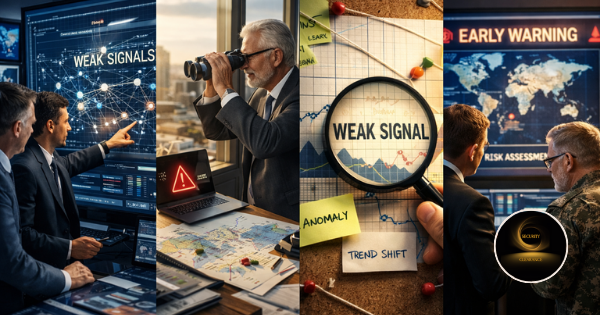
A weak signal is not weak in itself. It is weak because it does not fit dominant mental models. It is isolated, unconfirmed, often uncomfortable. It requires time, listening, and the willingness to suspend judgment.
Intelligence theory has long addressed this issue. Sherman Kent warned that analysis fails when attention is captured only by what is already visible and measurable. The cost is high: what is ignored grows unchecked.
This realization triggers subtle anger—the awareness that important signs were present but dismissed as “insufficient.” Not by mistake, but by habit.
Weak Does Not Mean Irrelevant
In my approach, a weak signal is not treated as proof, but as an hypothesis worth protecting. It deserves cognitive space, not immediate action.
Intelligence balances two risks:
– reacting too early,
– ignoring too long.
Decision-makers often discover that what harmed them was not the final event, but the inability to grant analytical dignity to early signals. This discovery sparks curiosity: how can I notice earlier next time?
How I Work With Weak Signals
My practice does not multiply alerts. It builds an intelligent listening system.
Operationally, I act on three levels:
- Non-conventional collection – peripheral sources, anomalous behaviors, micro-variations.
- Strategic contextualization – what changes if the signal grows.
- Evolutionary monitoring – observing without forcing conclusions.
When internalized, this method produces a new sensation: temporal advantage. Not knowing everything earlier, but knowing what to watch earlier.
From Surprise Effect to Preparedness
Weak signals are not meant to alarm. They are meant to prepare. They turn uncertainty into operational anticipation.
Concrete benefits follow:
– fewer impulsive reactions,
– greater strategic stability,
– earlier intervention at lower cost,
– stronger decision credibility.
A discreet form of joy emerges: the satisfaction of not being caught off guard. Not control, but vigilant presence.
Conclusion
Weak signals do not demand immediate answers. They demand attention. My work teaches how to recognize, protect, and interpret them before they become obvious to everyone.
When decision-makers learn to see what matters before it becomes evident, they stop chasing the present and begin to inhabit the future.