Introduction
The future does not betray decisions. Decisions betray the future when they imagine it as linear.
Most decision-makers—experienced ones included—build choices on a silent assumption: things will continue more or less as they are. It is comforting, but fragile.
My work addresses this fragility. Intelligence does not offer perfect forecasts; it builds decision resilience. Resilience emerges when a choice is designed to hold across multiple possible developments, not just one.
The Myth of Prediction
Intelligence is often confused with prediction. This is a conceptual mistake. Prediction guesses; intelligence prepares.
The analytical tradition initiated by Sherman Kent clarified that intelligence does not state what will happen, but helps decision-makers understand what might happen and with what implications.
This realization often generates frustration for past decisions built on a single future. It is productive frustration—it signals the need for a stronger method.
Scenarios as Instruments of Clarity
A scenario is not a story. It is a structure of possibilities designed to explore how variables may combine into different outcomes.
In my practice, scenario thinking serves three critical functions:
– breaking linear reasoning,
– reducing surprise effects,
– protecting decisions from contextual shifts.
Decision-makers often recognize, with retrospective anger, that so-called “unpredictable” events were actually unconsidered, not unimaginable. This awareness fuels curiosity: what would have changed if I had thought in scenarios?
Chapter 3 – How I Build Decision Scenarios
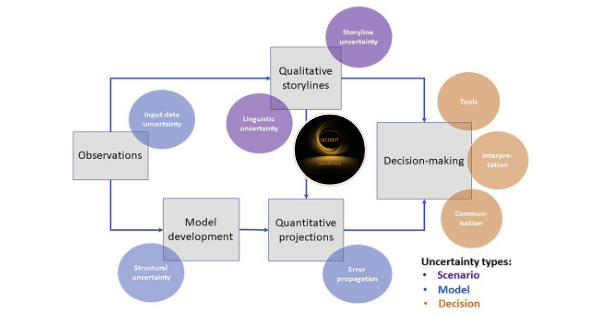
My approach does not generate endless hypotheses. I build a limited number of relevant scenarios—those that truly stress-test the decision.
Operationally, I follow four steps:
- Identifying critical variables – elements that truly alter outcomes.
- Controlled combination of variables – avoiding speculation.
- Impact assessment on the decision – what holds, what breaks.
- Decision adaptation – making the choice valid across contexts.
When done well, this produces strategic calm. Not because the future is known, but because it is no longer threatening.
Deciding Without Depending on the Future
The real advantage of scenario thinking is autonomy. A decision designed for multiple scenarios does not rely on a single outcome to remain valid.
This yields concrete benefits:
– greater temporal stability,
– fewer emergency corrections,
– increased stakeholder credibility,
– reduced anticipatory anxiety.
A quiet form of joy emerges: knowing that whatever happens, preparation is already in place.
Conclusion
Thinking in scenarios does not mean living in uncertainty. It means inhabiting uncertainty without being dominated by it. My work transforms the future from an undefined threat into a space of governable possibilities.
When a decision is designed for multiple possible worlds, it needs no defense. It endures—because it was built to last.