Tag: decision support

  • When cases are not won in court: the invisible value of Strategic Intelligence for law firms

    When cases are not won in court: the invisible value of Strategic Intelligence for law firms

    Beyond technology: the structural limits of legal AI

    Reuters correctly notes that AI can:

    • process vast volumes of precedents,
    • detect decision patterns,
    • support outcome prediction,
    • accelerate case preparation.

    Yet AI does not determine strategic relevance—it identifies statistical recurrence.

    A Strategic Intelligence consultant would have addressed this limitation by shaping how, when, and why information is used.

    Strategic Intelligence in the pre-litigation phase

    One of the most underestimated areas in the Reuters analysis is the pre-litigation phase.

    Strategic Intelligence would allow a law firm to:

    • map the real interests of counterparties, beyond legal positions;
    • analyze judges’ or arbitrators’ decision-making patterns from a behavioral, not merely statistical, perspective;
    • identify leverage points before litigation even begins;
    • evaluate alternative scenarios using structured probabilistic reasoning.

    Result:

    👉 fewer unnecessary lawsuits and higher strategic selectivity.

    Decision support during proceedings

    Reuters highlights how AI increasingly assists judges and mediators.

    What remains implicit is that this reshapes the cognitive environment of decision-makers.

    A Strategic Intelligence consultant could:

    • anticipate how AI-mediated analysis influences judicial perception;
    • adapt legal arguments to decision-making logic, not only legal doctrine;
    • prevent overreliance on automated outputs;
    • frame arguments in cognitively effective ways.

    In short:

    👉 using AI as part of the cognitive battlefield, not merely a tool.

    Managing reputational and ethical risk

    The Reuters article also touches on risks related to:

    • source reliability,
    • transparency,
    • professional accountability.

    Strategic Intelligence would provide:

    • verification protocols for AI-generated insights;
    • decision-traceability frameworks;
    • safeguards against ethical and disciplinary exposure;
    • reputational risk assessments linked to automated decision-making.

    Key point:

    👉 a lost case can be recovered; lost credibility cannot.

    A real competitive advantage for law firms

    The core lesson from Reuters is clear:

    law firms that merely “use AI” do not gain lasting strategic advantage.

    Those integrating Strategic Intelligence expertise can:

    • convert data into decision superiority,
    • anticipate opposing strategies,
    • choose when litigation is truly advantageous,
    • improve outcomes without increasing legal exposure.

    Conclusion

    The Reuters article does not describe a distant future—it documents an ongoing transformation.

    The real differentiator is not possessing AI tools, but embedding them within a coherent strategic intelligence framework.

    In this context, Strategic Intelligence does not replace legal expertise; it amplifies it—

    allowing law firms to see earlier, decide better, and risk less.

    And in complex litigation, that invisible advantage often determines who truly wins.

  • From complexity to clarity: the strategic value of synthesis

    From complexity to clarity: the strategic value of synthesis

    Introduction

    Complexity fascinates. It generates reports, charts, models, presentations. But it rarely generates better decisions.

    Modern decision-makers are immersed in more information than they can process, yet they keep adding analysis as if the problem were scarcity rather than excess.

    My work begins when complexity becomes paralyzing. Intelligence here performs a critical function: transforming complexity into clarity without betraying reality. This is where strategic synthesis is born.

    Why More Analysis Does Not Mean More Understanding

    A common error in decision processes is confusing depth with accumulation. Each new analysis appears to add value but often obscures the overall picture.

    Intelligence tradition has always distinguished analysis from synthesis. Sherman Kent emphasized that the analyst’s task is not to display everything known, but to make relevant meaning intelligible for decision.

    A recurring frustration emerges: “I know many things, but I don’t know what to do.” This signals the absence of synthesis. Without it, decisions remain suspended.

    Synthesis as an Act of Responsibility

    Synthesizing is not reducing. It is choosing what matters and assuming responsibility for excluding the rest. For this reason, synthesis is a decisional act, not a neutral one.

    In my approach, strategic synthesis answers three key questions:

    What truly changes the decision?

    What can be ignored without damage?

    What must be monitored but not acted upon now?

    This often triggers retrospective anger: realizing that past confusion stemmed not from lack of data, but from unmanaged excess. From this anger arises curiosity: what would deciding with less—but better—look like?

    Chapter 3 – How I Build Decision Synthesis

    My practice does not produce slogans. It produces frames of meaning. The synthesis I construct does not erase complexity—it organizes it.

    Operationally, I work across four levels:

    1. Information hierarchy – guiding elements, supporting elements, distractions.
    2. Connecting dispersed elements – revealing patterns, not lists.
    3. Translation into decision implications – what it means now.
    4. Stress-testing – what happens if context shifts.

    When this synthesis is sound, decision-makers experience clarity without naivety. Not simplification, but orientation.

    The Invisible Benefit: Speed Without Rush

    Good synthesis accelerates decisions without making them impulsive. It reduces time spent understanding and increases time spent choosing.

    Concrete benefits follow:

    – reduced decision paralysis,

    – greater coherence across choices,

    – clearer communication to stakeholders,

    – increased trust in the process.

    A composed form of joy emerges: the satisfaction of seeing clearly where opacity once ruled. Not dominance, but mastery.

    Conclusion

    Synthesis is not an intellectual luxury. It is a strategic necessity. My work restores a readable vision to decision-makers without impoverishing the reality they face.

    When complexity is synthesized correctly, decisions stop being burdens and become possible acts. And only when possible can a decision truly be good.

  • Accepting risk: why every mature decision is born from uncertainty

    Accepting risk: why every mature decision is born from uncertainty

    Introduction

    Every decision-maker eventually makes the same request: “I need a safe decision.”

    It is understandable—and misleading. Total safety is incompatible with real decision-making. Where certainty exists, there is no choice; where choice exists, risk follows.

    My work begins when this truth is accepted. Intelligence does not promise risk-free decisions. It offers the capacity to recognize, delimit, and consciously assume risk. This is where decisions mature.

    Denied Risk Is the Most Dangerous Risk

    In decision contexts, risk is often treated as an anomaly to be removed. More data is gathered, further analysis commissioned, additional opinions sought. Often, risk is not reduced—it is responsibility that is postponed.

    Intelligence thinking has always considered risk integral to decision-making. Sherman Kent clarified that analysis does not eliminate uncertainty—it defines its boundaries. Ignored risk does not disappear; it becomes invisible.

    A quiet anger emerges: realizing that many past decisions were fragile not because they were risky, but because risk was never named.

    The Difference Between Risk and Fear

    One of intelligence’s key contributions is separating risk from fear. Risk is strategic; fear is emotional. Confusing them leads to paralysis or defensive choices.

    In my approach, risk is treated as:

    partially quantifiable,

    linked to concrete consequences,

    acceptable or unacceptable by explicit criteria.

    This clarity often generates curiosity: “If risk is clear, why does it frighten me less?” Because fear thrives in vagueness, not definition.

    How I Work on Risk Acceptance

    I never ask decision-makers to “take risks.” I ask them to choose which risks to assume.

    Operationally, I work across three levels:

    1. Making real risks explicit – not imagined ones.
    2. Assessing consequences – what happens if risk materializes.
    3. Defining acceptance thresholds – what can be sustained.

    When these are clear, decisions change tone. They are no longer leaps into the void, but conscious steps. A sense of decision dignity emerges.

    The Hidden Benefit: Freedom to Decide

    Accepting risk liberates decision-makers—not by making them immune, but by freeing them from the illusion of total safety.

    Concrete benefits follow:

    – fewer strategic delays,

    – stronger alignment between values and choices,

    – greater decision stability,

    – ability to explain and defend decisions.

    A sober joy appears: freedom without self-deception. Not recklessness, but structured courage.

    Conclusion

    Every important decision carries risk. My work does not remove it; it makes it visible, measurable, and assumable.

    When risk is consciously accepted, decisions stop being emotional burdens and become adult acts. And only adult decisions truly endure over time.

  • Decision discipline: why deciding well is a practice, not a flash of genius

    Decision discipline: why deciding well is a practice, not a flash of genius

    Introduction

    Many decision-makers narrate success as intuition. Rarely do they describe failure as improvisation. Yet in daily practice, the absence of method is what makes decisions fragile and inconsistent.

    My work starts from a simple truth: deciding well once does not mean knowing how to decide. Intelligence does not create flashes of brilliance; it builds a discipline that makes quality repeatable.

    The Myth of Strategic Intuition

    Intuition has a role, but it cannot be the foundation of complex decision-making. It works in simple, repetitive, low-risk contexts. As complexity grows, intuition must be embedded in method.

    Intelligence tradition has long distrusted decision heroism. Sherman Kent emphasized that decision reliability depends on the solidity of the process, not the charisma of the decision-maker.

    This often generates frustration: realizing that “successful intuition” was not replicable. From this frustration arises interest in discipline.

    Discipline as a Stability Factor

    Decision discipline does not rigidify—it stabilizes. It limits the impact of mood, pressure, and emotional context, allowing decision-makers to distinguish between deciding and reacting.

    In my approach, discipline is built through:

    – consistent decision steps,

    – explicit evaluation criteria,

    – post-decision review moments.

    This reveals a retrospective anger: many past inconsistencies were not inevitable—they were structural.

    How I Build Decision Discipline

    I do not impose rigid procedures. I build strategic habits.

    Operationally, I work on three levels:

    1. Process formalization – always knowing where one is in deciding.
    2. Criteria repeatability – content changes, method remains.
    3. Learning from outcomes – each decision improves the next.

    When internalized, this discipline produces personal reliability—the ability to manage even error.

    The Competitive Advantage of Coherence

    Decision discipline generates coherence over time. Stakeholders begin to recognize a stable decision style, predictable in quality.

    Benefits include:

    – fewer reversals,

    – greater external credibility,

    – reduced decision stress,

    – continuity in crisis.

    A quiet joy emerges: the calm of not having to reinvent how to decide each time.

    Conclusion

    Deciding well is not a rare talent. It is a constructed practice. My work transforms decision-making from exceptional events into daily discipline.

    When discipline replaces improvisation, decisions stop reflecting the moment’s mood and start reflecting the decision-maker’s true stature.

  • Kodak: When Seeing the Future Is Not Enough

    Kodak: When Seeing the Future Is Not Enough

    Introduction

    Kodak is frequently used as a cautionary tale about innovation. But it is most useful for a different reason: it shows how an organization can recognize a structural shift and still fail to act on it. In intelligence terms, Kodak is not primarily a story of missing data. It is a story of unconverted insight—signals that were available, trends that were observable, and implications that were discussable, but that never became a decisive, coherent strategic posture.

    This is why Kodak remains one of the clearest applied cases for decision support: the company did not collapse because it lacked information. It collapsed because the organization could not translate what it knew into choices that were both timely and psychologically sustainable.

    The comforting myth: “Kodak didn’t get digital”

    Public explanations of corporate failure tend to favor simple causes. “They didn’t see it coming.” “They were obsolete.” “They lacked competence.” Kodak is often placed inside this category: a film company that could not understand the digital era.

    That story is comforting because it keeps the lesson at a safe distance. If failure is caused by ignorance, the cure is obvious: gather more information, hire better experts, follow the trend.

    Kodak is uncomfortable precisely because this cure does not apply. Kodak did not fail due to lack of awareness. Over decades, the organization had exposure to the technological direction, the market’s gradual behavioral changes, and the economic mechanisms that would eventually compress film margins and expand the convenience of digital photography.

    From an intelligence perspective, Kodak demonstrates a harsher reality: information can be correct, signals can be visible, and decisions can still be wrong—because the failure sits in interpretation, prioritization, timing, and organizational willingness to cannibalize the present in order to control the future.

    Information existed; strategic orientation did not

    The essential intelligence question is not “Was the organization informed?” but “Was the organization oriented?” These are not synonyms.

    An organization can be informed in multiple ways:

    • through technical R&D knowledge,
    • through market observation,
    • through competitive benchmarking,
    • through internal financial reporting.

    But orientation requires a different kind of work:

    • hierarchy of what matters,
    • scenario logic,
    • explicit choices between incompatible futures,
    • acceptance of irreversible trade-offs.

    Kodak’s problem was not that it lacked data; it was that the organization struggled to produce a clear, enforceable strategic direction from that data—especially when the direction threatened the existing economic engine.

    In intelligence terms, this is a conversion failure: the inability to transform dispersed insights into decision-ready judgment. When conversion fails, organizations often retreat into what they can measure reliably and control operationally. This retreat feels rational. It is also frequently fatal.

    The real strategic problem: inevitable cannibalization

    The most decisive strategic variable in Kodak’s case was not whether digital photography would exist. It was whether Kodak would accept a brutal premise: digital would cannibalize film.

    Once that premise is accepted, the strategic question becomes uncomfortable and very precise:

    • Is it better to cannibalize yourself early—while you still have cash, brand trust, distribution reach, and manufacturing scale to reinvest?
    • Or is it better to defend the existing model and allow external players to cannibalize you—while you gradually lose strategic freedom?

    Organizations often hesitate here because the “right” option is rarely painless. Self-cannibalization looks like self-harm in the short term: it threatens revenue, disrupts internal power structures, and forces people to admit that their core competence is becoming less valuable.

    Strategic intelligence is meant to make this dilemma explicit, quantify the cost of inaction, and show the long-run asymmetry between the two paths. When intelligence is weak or politically constrained, the organization delays the confrontation. Delay creates the illusion of stability. Meanwhile, the market decides.

    Kodak’s challenge was therefore not digital as a technology; it was digital as a decision that demanded intentional destruction of the old business model before the market forced that destruction externally.

    Organizational bias: past success as a distorting lens

    Cognitive bias is not a personal flaw; at scale, it becomes organizational structure. Kodak operated for decades with strong margins and a dominant position. That success created a predictable set of distortions:

    • Status quo bias: a preference for continuity because continuity has historically been rewarded.
    • Success bias: the belief that what worked will keep working because it has worked for a long time.
    • Overconfidence: the assumption that market leadership equals market control.
    • Framing bias: interpreting digital as a complement or niche rather than a replacement.

    These distortions are not irrational in the short term. They are adaptive responses to a stable environment. The problem is that disruption breaks the environment, while the organization’s mind keeps operating as if stability still holds.

    A mature intelligence function does not pretend to remove bias. It is designed to contain it by:

    • making assumptions explicit,
    • forcing alternative hypotheses,
    • testing “uncomfortable scenarios,”
    • separating operational performance from strategic viability.

    When this containment fails, the organization becomes highly competent at managing the present while becoming increasingly blind to the future.

    Kodak’s past did not only provide assets; it also provided the strongest resistance to reorientation.

    Strong operational analysis, weak strategic analysis

    Kodak’s operational excellence is part of the tragedy. In many failing organizations, operational incompetence is obvious. In Kodak’s case, the organization maintained strong capabilities in manufacturing, distribution, product quality, and process optimization.

    Operational analysis answers questions like:

    • How do we improve efficiency?
    • How do we protect margins?
    • How do we optimize distribution?
    • How do we control cost?

    These questions matter. But they operate within a stable model.

    Strategic analysis asks different questions:

    • Which model will survive?
    • Which part of our revenue is structurally threatened?
    • Which capabilities will remain valuable?
    • What must we abandon to remain in control?

    When strategic analysis is weak, operational analysis becomes a trap: it produces impressive short-term results while deepening long-term vulnerability. The organization can interpret operational strength as strategic strength, when in reality it is merely the efficient execution of a model whose lifespan is shrinking.

    From an intelligence standpoint, this is a classic mismatch between “local rationality” and “systemic rationality.” Each decision can be rational in isolation. The aggregate outcome becomes irrational.

    Timing: the silent enemy of strategic decisions

    Even when leadership recognizes the direction of change, timing determines whether recognition becomes advantage or regret.

    In disruption dynamics, the window of strategic freedom is finite:

    • Early: the incumbent has resources and legitimacy to reshape itself.
    • Mid: the incumbent can still pivot but pays a higher price, with more internal conflict.
    • Late: the pivot becomes survival-driven, reactive, and often too slow.

    Intelligence is not only about what is true; it is about what is true in time. An analysis that arrives after the decision window is closing becomes documentation, not guidance.

    Kodak’s case illustrates a timing trap: you can see the trend early but still behave as if you can postpone the moment of decision indefinitely. The market does not respect internal timelines. It moves on adoption, cost curves, and behavioral shifts.

    The intelligence function, when properly positioned, makes timing visible: it identifies the moment when “waiting for more certainty” becomes the most dangerous choice of all.

    What intelligence would have done differently

    It is important to avoid a simplistic counterfactual: intelligence does not guarantee success. Markets are complex and competition is brutal. The question is not “Would intelligence have saved Kodak?” but “What would intelligence have changed in the decision posture?”

    A serious intelligence approach could have improved Kodak’s decision architecture by:

    1. Separating present performance from future sustainability Strong film profits could have been treated as fuel for transformation, not proof that transformation could be delayed.
    2. Making cannibalization a strategic hypothesis, not a taboo Instead of treating self-disruption as unacceptable, intelligence would force a clear comparison: the cost of self-cannibalization versus the cost of being cannibalized.
    3. Building disciplined scenarios, not narratives Not “digital is coming,” but structured alternatives: adoption pace, consumer behavior, new entrants, cost declines, supply chain changes, and what each scenario implies for Kodak’s position.
    4. Stress-testing assumptions What if margins collapse faster than expected? What if new entrants control distribution channels? What if consumers stop valuing print? What if smartphones become the default camera?
    5. Reducing confirmation bias at the top By institutionalizing challenge functions: red-teaming, alternative hypotheses, and dissent mechanisms that prevent leadership from selecting only comforting information.

    None of these steps produce certainty. They produce direction.

    The core lesson: knowing is not deciding

    The deepest value of the Kodak case is not the technological timeline. It is the intelligence principle it reveals:

    • Data does not equal understanding.
    • Understanding does not equal orientation.
    • Orientation does not equal decision.
    • Decision does not equal execution unless the organization accepts painful trade-offs.

    Kodak’s failure shows what happens when an organization remains trapped between two incompatible futures: it tries to preserve the old model while tentatively exploring the new one, without committing enough to reshape itself.

    This “half-step” strategy is psychologically appealing. It feels balanced. In disruption, it is often the worst option: it sacrifices the chance to lead the new era while still weakening the old one.

    Strategic intelligence exists to prevent exactly this: the prolonged postponement of a decision that the environment has already made inevitable.

    Why Kodak matters to decision-makers today

    Kodak is not a museum case. It is a recurring pattern in modern organizations because the conditions that created it are now common:

    • rapid technological substitution,
    • platform shifts,
    • changing consumer behavior,
    • reputational volatility,
    • information overload that creates the illusion of control.

    The Kodak lesson is not “embrace technology.” It is “embrace decision clarity under uncertainty.” Often the most dangerous move is to treat a structural shift as optional.

    Intelligence adds value when it does one thing well: it forces decision-makers to see that certain futures are incompatible—and that delaying choice is itself a choice with a cost.

    Conclusion

    Kodak did not fail because it could not see the future. It failed because it could not decide what to do with what it could already see.

    That is the essential intelligence warning for any leader operating in uncertainty: the highest risk is not ignorance; it is the illusion that knowledge automatically turns into action. Intelligence, at its best, does not predict the future. It helps decision-makers take difficult decisions while the future is still open.
  • Kodak vs Boeing 737 MAX. When Intelligence Exists but Decisions Fail

    Kodak vs Boeing 737 MAX. When Intelligence Exists but Decisions Fail

    Introduction

    At first glance, Kodak and the Boeing 737 MAX appear impossible to compare. One represents a century-old photography company facing digital disruption; the other, a global aerospace manufacturer operating in one of the most regulated and safety-critical industries in the world.

    Yet from an intelligence and decision-making perspective, these two cases are structurally similar.

    In both situations, critical information was available well in advance. Warning signals were present. Internal expertise was strong. The organizations were not ignorant, nor were they technically incapable. What failed was the translation of intelligence into binding strategic decisions.

    This article does not examine Kodak and Boeing as stories of technological failure or engineering error. Instead, it analyzes them as two manifestations of the same strategic pathology: intelligence that exists, but does not constrain decision-making when pressure, bias, and timing collide.

    Information without orientation: a shared starting point

    The first and most important similarity between Kodak and Boeing is that neither organization suffered from a lack of information.

    Kodak understood digital imaging early. It developed prototypes, studied sensor evolution, monitored consumer behavior, and tracked cost trajectories. Boeing, in the case of the 737 MAX, was fully aware of the aircraft’s design constraints, the operational implications of system changes, and the pressures introduced by accelerated certification and training simplifications.


    Il contenuto che hai scelto è riservato.


  • Why Law Firms Lose Cases They Could Have Won

    Why Law Firms Lose Cases They Could Have Won

    Introduction

    Within law firms, defeats are often explained through external factors: unpredictable judges, unfavorable case law, political interference, or aggressive counterparts.

    These explanations are sometimes valid—but rarely sufficient.

    In an increasing number of complex disputes, cases are not lost because the legal reasoning is flawed, but because it is strategically isolated: correct in law, blind in context.

    This is where intelligence becomes decisive.

    The myth of the “case lost because of the law”

    Legal culture tends to explain outcomes as a direct function of legal correctness.

    If the law supports us, we should win.

    If we lose, the law must have failed.

    In complex litigation, this assumption no longer holds.

    The law is necessary—but rarely sufficient.


    Il contenuto che hai scelto è riservato.


  • If You Are a Small Business Owner, You Should Consider an Intelligence Service

    If You Are a Small Business Owner, You Should Consider an Intelligence Service

    Introduction

    When small business owners hear the word intelligence, they often think:

    “That’s not for me. I run a small company, not a multinational.”

    This reaction is understandable—and deeply misleading.

    Intelligence was not created for large organizations.

    It was created for decision-makers operating with uncertainty, pressure, and limited margins for error.

    And that is exactly the condition of a small business owner.

    The real problem is not lack of data

    Small business owners are not uninformed.

    They are overwhelmed.

    Sales figures, tax indicators, consultants’ advice, banks’ expectations, suppliers’ opinions—information is everywhere.

    The problem is not quantity.


    Il contenuto che hai scelto è riservato.


  • Strategic Analysis and Operational Analysis: Two Different Levels

    Strategic Analysis and Operational Analysis: Two Different Levels

    Introduction

    In organizational and managerial language, the terms strategic and operational are often used interchangeably.

    This overlap is not harmless: it reflects a conceptual confusion that, in intelligence, can undermine decision quality.

    Strategic analysis and operational analysis answer different questions, operate on different time horizons, and produce non-overlapping outputs. Understanding their distinction is essential to using intelligence correctly.

    Strategic Analysis: Long-Term Orientation

    Strategic analysis focuses on the medium to long term.

    Its purpose is not to guide immediate action, but to help decision-makers understand:

    • structural trends,
    • contextual dynamics,
    • emerging balances and imbalances,
    • possible trajectories.

    It operates at a level of orientation, not execution.

    It works with scenarios, probabilities, and alternative hypotheses, accepting uncertainty as intrinsic to its value.

    Operational Analysis: Supporting Action

    Operational analysis, by contrast, is oriented toward the short term and concrete action.

    It addresses questions such as:

    • what should be done now?
    • with which resources?
    • under which immediate risks?

    Here, detail is higher, constraints are tighter, and time is often critical.

    Operational analysis does not build long-term visions; it supports specific decisions in defined contexts.

    Why Confusing Them Is Dangerous

    Treating strategic analysis as operational leads to demands it cannot satisfy.

    Treating operational analysis as strategic leads to overgeneralizing short-term decisions.

    In both cases, the risk is the same: using a well-executed analysis for the wrong purpose.

    Complementarity Between the Two Levels

    Strategic and operational analysis are not alternatives, but complementary layers.

    The former provides the framework within which the latter gains meaning.

    The latter translates broader orientations into concrete action.

    A mature intelligence system keeps these levels distinct and manages the transition between them carefully.

    Conclusion

    Confusing strategy and operations means losing both vision and effectiveness.

    Intelligence works when it recognizes that not all decisions are of the same nature, and that different questions require different analyses.

    Conceptual clarity here is not theoretical—it is a practical condition for better decisions.

  • The hidden cost of indecision: when not choosing is already a choice

    Introduction

    Many decision-makers tell themselves a comforting story: I haven’t decided yet because I’m still evaluating. It sounds responsible, even wise. Yet behind this narrative lies an uncomfortable truth: every non-decision produces real effects.

    My work begins when time becomes critical and no one dares to say it openly. Intelligence does not push for impulsive action; it anchors decisions to responsibility. Because the real danger is not deciding too early, but deciding too late without realizing it.

    Indecision as a Passive Strategy

    In many organizations, indecision is rewarded. Postponement avoids visible mistakes, shifts responsibility to circumstances, and waits for events to decide. It is a passive strategy with short-term benefits.

    Over time, however, it causes silent damage:

    – loss of initiative,

    – erosion of internal trust,

    – increased exposure to external shocks.

    Intelligence has always treated time as a decisive variable. Sherman Kent warned that perfect information arriving too late is strategically useless. The same applies to decisions: quality without timing is refined inefficiency.

    Time as a Risk Factor

    In my approach, time is not neutral. It is a risk multiplier. Every day of delay alters the context, shifts balances, and changes actors’ intentions.

    Decision-makers often discover, with discomfort, that what once was a solid analysis becomes obsolete. Not because it was wrong, but because reality did not wait. This realization generates a distinct form of anger: understanding that waiting was not neutral, but actively destructive.

    This is where interest grows in a method that does not merely analyze, but integrates time into decision-making.

    How I Intervene on Indecision

    I do not force decisions. I make the cost of delay visible. When that cost is clear, decisions cease to be emotional and become rational.

    Operationally, I work along three lines:

    1. Analyzing the consequences of not deciding – what happens if nothing changes.
    2. Defining decision windows – when a choice still matters.
    3. Clarifying responsibility – who bears the cost of waiting.

    This restores control over time. Not by rushing, but by choosing the moment consciously. It is a decisive shift that gives strategic dignity back to action.

    From Fear of Error to Responsibility for Choice

    Many delays stem from a legitimate fear: making mistakes. Intelligence reveals an uncomfortable truth: not choosing often carries greater risk than an imperfect choice.

    When method replaces hesitation, an internal transformation occurs. Fear gives way to mature responsibility—the awareness that every choice has a cost, but that the cost of inaction is almost always higher.

    What emerges is a deep sense of relief. Not excitement. Relief. The relief of no longer being hostage to time, but able to inhabit it.

    Conclusion

    Indecision is not the absence of choice. It is a choice operating in the shadows. My work brings it into the open—measurable, discussable, governable.

    Those who integrate intelligence into their decision process discover that time ceases to be an enemy and becomes a strategic variable. And when time returns as a resource, decisions stop weighing down and start sustaining action.

  • Decision accountability: why power weighs only when it is real

    Introduction

    “Accountability” is often invoked as an abstract value. In reality, it is concrete, measurable, and frequently avoided. Many decision-makers seek control; few accept full accountability. The difference is decisive: control tries to prevent error, accountability accepts error as a possible cost of conscious choice.

    My work operates precisely at this transition. Intelligence does not inflate the decision-maker’s ego; it strengthens their capacity to sustain. When accountability is structured, power ceases to be an emotional burden and becomes a governable function.

    Role, Power, Accountability: A Common Confusion

    In many organizations, role is mistaken for accountability. Executives “decide” but do not always truly answer for consequences. This dissociation produces defensive choices, strategic delays, and opaque delegation.

    Intelligence theory has long distinguished formal authority from effective accountability. Sherman Kent emphasized that analysis has value only when someone is willing to use it and assume the risk. Without that assumption, even excellent intelligence remains harmless.

    A first uncomfortable realization often emerges: having decided without truly exposing oneself. It generates resistance—and openness.

    Accountability as Structure, Not Virtue

    Accountability is not a moral trait. It is a decision structure. When absent, decision-makers seek protection: redundant procedures, multiple opinions, diluted consensus. When present, they seek clarity.

    In my approach, accountability is operationalized through three elements:

    clear decision boundaries,

    explicit consequence scenarios,

    risk acceptability criteria.

    This often triggers retrospective anger: “I could have decided earlier if I had seen it this way.” It is not sterile regret. It is the discovery that accountability weighs less when anticipated and structured.

    How I Work on Decision Accountability

    I never ask decision-makers to “take more responsibility.” Instead, I create conditions where accountability becomes inevitable yet sustainable.

    Operationally, I act on three levels:

    1. Making consequences explicit – what happens in each plausible scenario.
    2. Reducing ambiguity – what is not decided is an implicit choice.
    3. Aligning decision and identity – who you are when you choose.

    When these are clear, a shift occurs: defense gives way to governance. Decisions become positions, not reactions.


    The Invisible Benefit: Authority Without Rigidity

    Well-structured accountability generates authority—not imposed, but recognized. People follow those who bear consequences, not those who hide behind process.

    Concrete outcomes follow:

    – increased internal trust,

    – reduced latent conflict,

    – faster decisions without impulsivity,

    – greater strategic stability.

    A new sensation emerges: solidity. Not excitement. Solidity—the ability to hold what one decides.

    Conclusion

    Decision accountability is not declared. It is built. My work provides that construction: making explicit what is usually implicit, measuring what is avoided, anticipating what would otherwise erupt later.

    When accountability is real, power stops weighing down. And when power no longer weighs, decisions finally become inhabitable.

  • Thinking in scenarios: deciding today without being surprised tomorrow

    Thinking in scenarios: deciding today without being surprised tomorrow

    Introduction

    The future does not betray decisions. Decisions betray the future when they imagine it as linear.

    Most decision-makers—experienced ones included—build choices on a silent assumption: things will continue more or less as they are. It is comforting, but fragile.

    My work addresses this fragility. Intelligence does not offer perfect forecasts; it builds decision resilience. Resilience emerges when a choice is designed to hold across multiple possible developments, not just one.

    The Myth of Prediction

    Intelligence is often confused with prediction. This is a conceptual mistake. Prediction guesses; intelligence prepares.

    The analytical tradition initiated by Sherman Kent clarified that intelligence does not state what will happen, but helps decision-makers understand what might happen and with what implications.

    This realization often generates frustration for past decisions built on a single future. It is productive frustration—it signals the need for a stronger method.

    Scenarios as Instruments of Clarity

    A scenario is not a story. It is a structure of possibilities designed to explore how variables may combine into different outcomes.

    In my practice, scenario thinking serves three critical functions:

    – breaking linear reasoning,

    – reducing surprise effects,

    – protecting decisions from contextual shifts.

    Decision-makers often recognize, with retrospective anger, that so-called “unpredictable” events were actually unconsidered, not unimaginable. This awareness fuels curiosity: what would have changed if I had thought in scenarios?

    Chapter 3 – How I Build Decision Scenarios

    My approach does not generate endless hypotheses. I build a limited number of relevant scenarios—those that truly stress-test the decision.

    Operationally, I follow four steps:

    1. Identifying critical variables – elements that truly alter outcomes.
    2. Controlled combination of variables – avoiding speculation.
    3. Impact assessment on the decision – what holds, what breaks.
    4. Decision adaptation – making the choice valid across contexts.

    When done well, this produces strategic calm. Not because the future is known, but because it is no longer threatening.

    Deciding Without Depending on the Future

    The real advantage of scenario thinking is autonomy. A decision designed for multiple scenarios does not rely on a single outcome to remain valid.

    This yields concrete benefits:

    – greater temporal stability,

    – fewer emergency corrections,

    – increased stakeholder credibility,

    – reduced anticipatory anxiety.

    A quiet form of joy emerges: knowing that whatever happens, preparation is already in place.

    Conclusion

    Thinking in scenarios does not mean living in uncertainty. It means inhabiting uncertainty without being dominated by it. My work transforms the future from an undefined threat into a space of governable possibilities.

    When a decision is designed for multiple possible worlds, it needs no defense. It endures—because it was built to last.

  • Weak signals: seeing what matters before it becomes obvious

    Weak signals: seeing what matters before it becomes obvious

    Introduction

    When an event is labeled “unforeseen,” it almost always was—only for those unwilling to see.

    Organizations and decision-makers fail not because they are blind, but because they are trained to look elsewhere: at consolidated numbers, familiar certainties, and confirmations of existing direction.

    My work begins before the crisis, in the uncomfortable zone where signals are ambiguous and do not yet justify visible action. Intelligence here does not deliver dramatic alerts; it builds selective attention. That attention is the difference between being surprised and being prepared.

    Why Weak Signals Are Ignored

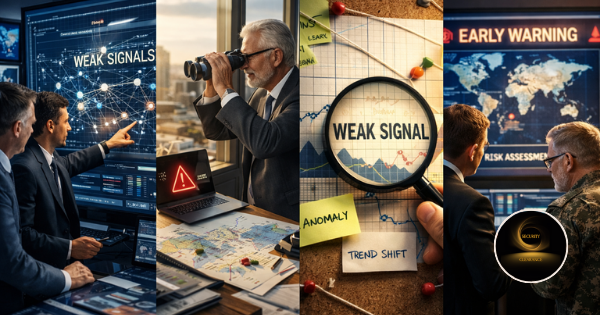
    A weak signal is not weak in itself. It is weak because it does not fit dominant mental models. It is isolated, unconfirmed, often uncomfortable. It requires time, listening, and the willingness to suspend judgment.

    Intelligence theory has long addressed this issue. Sherman Kent warned that analysis fails when attention is captured only by what is already visible and measurable. The cost is high: what is ignored grows unchecked.

    This realization triggers subtle anger—the awareness that important signs were present but dismissed as “insufficient.” Not by mistake, but by habit.

    Weak Does Not Mean Irrelevant

    In my approach, a weak signal is not treated as proof, but as an hypothesis worth protecting. It deserves cognitive space, not immediate action.

    Intelligence balances two risks:

    – reacting too early,

    – ignoring too long.

    Decision-makers often discover that what harmed them was not the final event, but the inability to grant analytical dignity to early signals. This discovery sparks curiosity: how can I notice earlier next time?

    How I Work With Weak Signals

    My practice does not multiply alerts. It builds an intelligent listening system.

    Operationally, I act on three levels:

    1. Non-conventional collection – peripheral sources, anomalous behaviors, micro-variations.
    2. Strategic contextualization – what changes if the signal grows.
    3. Evolutionary monitoring – observing without forcing conclusions.

    When internalized, this method produces a new sensation: temporal advantage. Not knowing everything earlier, but knowing what to watch earlier.

    From Surprise Effect to Preparedness

    Weak signals are not meant to alarm. They are meant to prepare. They turn uncertainty into operational anticipation.

    Concrete benefits follow:

    – fewer impulsive reactions,

    – greater strategic stability,

    – earlier intervention at lower cost,

    – stronger decision credibility.

    A discreet form of joy emerges: the satisfaction of not being caught off guard. Not control, but vigilant presence.

    Conclusion

    Weak signals do not demand immediate answers. They demand attention. My work teaches how to recognize, protect, and interpret them before they become obvious to everyone.

    When decision-makers learn to see what matters before it becomes evident, they stop chasing the present and begin to inhabit the future.

  • When Wrong Decisions Come from Correct Information

    When Wrong Decisions Come from Correct Information

    Introduction

    In common discourse, decision failures are often attributed to incorrect or incomplete information.

    This explanation is comforting, because it points to an external and seemingly fixable cause: “the data was missing” or “the information was wrong.”

    In practice, however, many failed decisions arise from a less intuitive paradox: the information was correct, yet the decision was still wrong.

    Understanding this paradox is essential to grasp the true value of intelligence.

    Correct Information Does Not Guarantee Good Decisions

    Information may be:

    • accurate,
    • verified,
    • up to date,

    and still be decisionally inadequate.

    This happens when information is:

    • not prioritized,
    • not connected,
    • not interpreted within its context.

    Without analytical work, information remains descriptive rather than directive.

    The Problem Is Not What Is Known, but How It Is Used

    Many wrong decisions do not stem from ignorance, but from misuse of available knowledge.

    Common mechanisms include:

    • overreliance on a single indicator,
    • linear interpretation of complex phenomena,
    • drawing conclusions without considering alternatives.

    In such cases, the error is not informational, but interpretive.

    Context as the Decisive Factor

    Information is always true within a context.

    Outside that context, it can become misleading.

    Wrong decisions often arise when:

    • valid data is applied to changed scenarios,
    • past indicators are automatically projected into the future,
    • weak signals are ignored because they are not “measurable.”

    Intelligence exists precisely to re-anchor information within its operational context.

    When Internal Coherence Becomes a Trap

    Another risk lies in building decision frameworks that are internally coherent but externally fragile.

    When all information “fits,” decision-makers may develop a sense of certainty that suppresses doubt.

    In such situations:

    • alternative hypotheses are not explored,
    • divergent scenarios are not tested,
    • low-probability, high-impact events are ignored.

    The decision appears solid, but is closed in on itself.

    The Role of Intelligence

    Intelligence does not exist to provide “better” information in an absolute sense.

    It exists to:

    • put available information under tension,
    • expose latent inconsistencies,
    • reveal what information does not say.

    Its main contribution is not adding data, but preventing correct data from being used incorrectly.

    Conclusion

    Wrong decisions do not always arise from wrong information.

    They often arise from correct information used without method.

    When practiced rigorously, intelligence does not protect against error.

    It protects against the illusion that knowing something automatically means deciding well.

  • Decision-Making Under Pressure: What Changes When Time Is Scarce

    Decision-Making Under Pressure: What Changes When Time Is Scarce

    Introduction

    When time is abundant, decisions can rely on in-depth analysis, extended comparison, and revision.

    When time is scarce, everything changes. Time pressure alters not only pace, but the quality of the decision-making process itself.

    Many errors attributed to lack of information or contextual complexity actually stem from a simpler and more powerful factor: time compression.

    Time Pressure as a Risk Multiplier

    Limited time does not automatically produce bad decisions, but it amplifies existing weaknesses in the decision process.

    Under pressure:

    • alternatives are narrowed,
    • information is simplified,
    • opportunities for revision shrink.

    The risk is not speed itself, but speed without structure.

    What Happens to the Intelligence Cycle When Time Is Limited

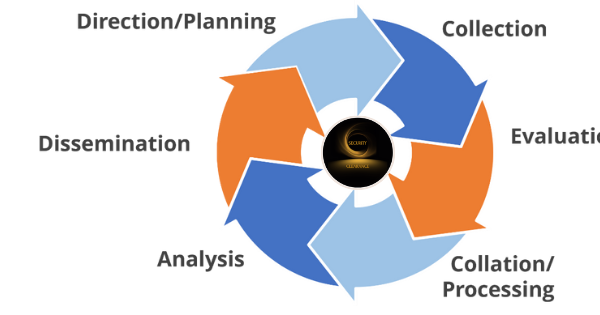
    Under ideal conditions, the intelligence cycle allows for:

    • clarification of information needs,
    • collection and analysis,
    • evaluation and dissemination.

    When time is scarce, the cycle does not disappear—it is compressed.

    Problems arise when compression turns into omission:

    • analysis is replaced by rapid inference,
    • evaluation yields to urgency,
    • dissemination becomes rushed communication.

    The result is not efficiency, but loss of quality.

    Speed Is Not the Same as Urgency

    A critical distinction must be made between:

    • fast decisions,
    • urgent decisions.

    A decision can be fast and structured.

    An urgent decision is often fast because it cannot afford structure.

    Confusing these conditions leads to justifying fragile choices in the name of time, when the real issue is lack of preparation.

    The Return of Cognitive Shortcuts

    Under time pressure, decision-makers tend to:

    • rely on past experience,
    • favor familiar solutions,
    • reduce complexity to known patterns.

    These shortcuts are not irrational, but become dangerous when:

    • contexts have changed,
    • problems are novel,
    • consequences are significant.

    In such cases, time accelerates the impact of cognitive bias.

    The Role of Intelligence Under Urgency

    Intelligence cannot eliminate time pressure, but it can:

    • preserve minimal structure,
    • maintain separation between facts and assumptions,
    • clarify what is known and what remains uncertain.

    Even under pressure, its value lies not in slowing decisions, but in preventing urgency from erasing thinking.

    Conclusion

    Deciding under pressure does not require abandoning quality, but adopting a different form of awareness.

    Lack of time is never the true problem.

    The problem is how the lack of time is managed.

    In these contexts, intelligence does not exist to delay decisions, but to prevent speed from turning into blindness.

  • Why Companies Fail Despite Having All the Data

    Why Companies Fail Despite Having All the Data

    Introduction

    Public narratives of corporate failure often attribute collapse to lack of information: misunderstood markets, ignored signals, missing data.

    This explanation is incomplete. In many cases, companies fail despite having vast amounts of data, accurate reports, and advanced monitoring systems.

    The problem is not information scarcity, but the inability to turn information into coherent decision guidance.

    Information Abundance as a False Advantage

    Complex organizations continuously produce and collect data: performance, sales, risk, compliance, market indicators.

    This abundance is often seen as an automatic competitive advantage.

    In reality, when data is:

    • not integrated,
    • not prioritized,
    • not read systemically,

    it becomes a source of organizational confusion, not clarity.

    Distributed Data, Fragmented Decisions

    A recurring issue is information fragmentation.

    Different functions observe different slices of reality:

    • finance focuses on numbers,
    • sales on trends,
    • legal on risk,
    • operations on urgency.

    Without analytical synthesis, each function makes decisions that are locally rational, while the organization as a whole loses coherence.

    Failure arises not from local error, but from the accumulation of disconnected decisions.

    The Illusion of Control Through KPIs

    Indicators and KPIs are valuable tools, but become dangerous when they replace strategic thinking.

    What can be measured is prioritized, while what is:

    • qualitative,
    • emerging,
    • not immediately quantifiable,

    is often neglected.

    The organization may appear under control while actually losing situational awareness.

    When Analysis Exists but Does Not Guide

    In many organizations, analysis exists but has little impact.

    It is produced to:

    • satisfy procedures,
    • formally inform,
    • “cover” the decision-making process.

    When analysis is not integrated into the moment of choice, it becomes documentation, not support.

    In such cases, failure is not analytical, but decisional.

    The Role of Intelligence in Organizations

    Intelligence applied to business contexts is not about producing more reports.

    It is about:

    • connecting dispersed information,
    • highlighting tensions between apparently consistent data,
    • refocusing attention on the implications of choices.

    Its value emerges when it helps organizations see themselves as systems, not as collections of departments.

    Conclusion

    Companies do not fail because they lack knowledge.

    They fail because they know many things but do not know how to use them when deciding.

    In this context, intelligence is not an analytical luxury.

    It is the means by which information abundance is transformed into strategic direction, before fragmentation becomes irreversible.

  • Deciding better is not a talent. It is a method.

    Deciding better is not a talent. It is a method.

    Introduction

    There is a precise moment every decision-maker recognizes, often silently: the moment of deciding without having enough. Not enough time, not enough clarity, not enough certainty. Information accumulates, but understanding does not. And under pressure, experience is often mistaken for method.

    This is where my work begins. Not when everything is clear, but when it is not. The intelligence I apply has nothing to do with espionage myths. It is a rigorous discipline designed to reduce uncertainty and protect decision-makers from unseen consequences. In this article, I guide the reader through the theoretical foundations of intelligence and then into the concrete practice I apply to real decision-making environments.

    What Intelligence Really Is (and What It Is Not)

    In common language, intelligence is often confused with spying, investigations, or raw information gathering. In reality, intelligence is an analytical discipline designed to support decision-making. Its purpose is not to know more, but to understand better.

    Classical intelligence theory, introduced by Sherman Kent, defines intelligence as the production of timely, relevant, and reliable knowledge for decision-makers. This implies a hard truth: most available information is useless unless it is evaluated, contextualized, and interpreted.

    Organizations often suffer from data saturation. Reports multiply, dashboards expand, meetings proliferate. Intelligence works in the opposite direction: it filters, connects, and prioritizes. It reduces noise so that the signal can emerge.

    The Critical Transition: From Information to Decision

    Intelligence has value only at the moment of choice. A brilliant analysis that does not influence a decision is sterile. For this reason, my work is never neutral—it is always action-oriented.

    Each piece of information is assessed through three decisive lenses:

    Reliability (Can it be trusted?)

    Relevance (Does it affect the decision?)

    Impact (What changes if it is considered—or ignored?)

    This process often triggers a strong emotional reaction: anger. Anger for past decisions made on intuition alone, for avoidable costs, for missed opportunities. It is a productive anger—it marks the awareness that decisions were taken without adequate structure.

    How I Work: My Applied Intelligence Practice

    What I offer is not a standardized service. It is a decision-support process. I enter complex environments with one goal: to make the decision-maker clearer, not dependent.

    My practice operates on four integrated levels:

    1. Mapping the real context – not the declared one, but the factual one.
    2. Analyzing actors and intentions – what drives behavior, not what is said.
    3. Building alternative scenarios – to escape single-track thinking.
    4. Supporting the final choice – clarifying risks, consequences, and margins.

    The outcome is not the “right” decision, but a defensible, coherent, conscious one. This is where curiosity arises: the discovery that there is a stronger, safer, more productive way to think.

    The Invisible (Yet Decisive) Benefits

    Applying an intelligence-based method produces effects beyond individual decisions. Time quality improves, anticipatory anxiety decreases, reactive choices diminish. Productivity increases not because more is done, but because fewer mistakes are made.

    There is also a deeper benefit: decision security. Knowing that everything reasonably knowable has been considered radically changes how consequences are faced—even difficult ones.

    Here emerges a final emotion: a quiet, mature sense of relief. Not excitement, but steadiness. The relief of no longer facing complexity alone.

    Conclusion

    My work does not promise certainty. It offers something rarer: the reduction of relevant ignorance. In a world obsessed with speed, intelligence restores depth. Where everyone speaks, it teaches how to listen to weak signals. Where urgency dominates, it introduces method.

    Those who reach the end of this article do not need persuasion. They need only recognize an uncomfortable truth: the best decisions are not born of courage, but of clarity. And clarity, when it truly matters, is never accidental.

  • When decisions fail: why it’s not the information, but the method

    When decisions fail: why it’s not the information, but the method

    Introduction

    There is a comforting but deeply misleading belief in decision-making environments: if I have enough information, I will decide well. It is reassuring because it shifts responsibility outward. When things go wrong, the explanation becomes external—missing data, unforeseen variables, late reports.

    Reality is harsher. Most poor decisions are not caused by lack of information, but by the way available information is used. My work begins precisely at this realization. Intelligence does not enter to add data, but to dismantle the illusions that make fragile decisions appear solid.

    The Information Paradox: More Data, More Errors

    Over the past decades, data collection capabilities have exploded. Sophisticated reports, predictive analytics, performance indicators. Yet decision failures have not declined. In many contexts, they have increased.

    This paradox is well known in intelligence studies: information overload distorts judgment. Under pressure, decision-makers select only data that confirms their initial assumptions, systematically ignoring contradictory signals. This creates decisions that are defensible—but wrong.

    At this stage, a first strong emotion emerges: anger. Anger for realizing that costly mistakes were not caused by incompetence, but by the absence of a method. When properly directed, this anger becomes the engine of change.

    Intelligence as an Antidote to Decision Bias

    Intelligence was historically developed to counter exactly these failures. Modern intelligence theory, initiated by Sherman Kent, focuses on the relationship between knowledge and decision, not between information and truth.

    In my approach, intelligence functions as a cognitive defense system. It helps identify:

    – implicit decision-maker biases,

    – unrecognized emotional pressures,

    – interests disguised as objective analysis,

    – weak signals systematically ignored.

    This stage is often destabilizing. Decision-makers discover that the most dangerous threat is not external, but misplaced trust in their habitual way of deciding. This is where curiosity arises: if my usual process is unreliable, what alternative exists?

    How I Intervene: Deconstruct Before Building

    My applied intelligence practice follows a precise rule: disarm first, then construct. I never start by offering solutions. I start by challenging certainties.

    Operationally, I work through three preliminary levels:

    1. Reconstructing past decisions – how choices were truly made, not how they are narrated.
    2. Identifying distortions – informational, cognitive, relational.
    3. Separating facts, interpretations, and desires – a painful but essential step.

    Only then does a structured intelligence method become possible. This marks a turning point: the decision-maker experiences the rare sensation of observing the problem from outside. Decision quality changes not by intuition, but by structure.

    From Control to Reliability: What Truly Changes

    When the intelligence method is internalized, something counterintuitive happens: the decision-maker feels less need for control. Not because responsibility is abandoned, but because the process holds.

    This produces tangible benefits:

    – reduced decision anxiety,

    – greater coherence across choices,

    – increased internal and external credibility,

    – a sharp rise in strategic productivity.

    Here emerges the most powerful and discreet emotion: a quiet, mature sense of relief. The relief of no longer chasing decisions, but governing them.

    Conclusion

    Decisions do not fail because of missing information. They fail because no one teaches how to use information under pressure. My work fills this gap by introducing a method that protects decision-makers from their own automatisms and contextual traps.

    Those who reach this point recognize a critical truth: continuing to decide as one always has is not prudence—it is exposure. Intelligence does not eliminate uncertainty; it makes it livable. And only within a livable space can decisions cease to be gambles and become choices.

  • The decision-maker’s blind spots: why failure begins before the choice

    The decision-maker’s blind spots: why failure begins before the choice

    Introduction

    Most decision-makers are not afraid of making mistakes. They fear the consequences afterward. What they rarely fear—but should—is not seeing.

    The real decision risk is not choosing incorrectly, but choosing without realizing what has been excluded from the field of vision. My work starts from this reality: every decision process creates blind zones by default. Intelligence does not aim to illuminate everything—an impossible task—but to make decision-makers aware of their perceptual limits. Only from that awareness can solid decisions emerge.

    Blind Spots Are Not Errors, They Are Structures

    A blind spot is not an occasional distraction. It is a stable cognitive structure shaped by experience, role, expectations, and pressure. The more experienced a decision-maker becomes, the more consolidated these blind spots tend to be.

    Intelligence studies have long recognized this phenomenon. Sherman Kent emphasized that the core issue is not missing information, but the inability to assign proper weight due to pre-existing mental frameworks.

    This realization often generates subtle frustration: discovering that experience alone does not protect against error. In many cases, it reinforces it. This frustration is necessary—it cracks the illusion of infallibility.

    What Is Not Seen Matters More Than What Is Analyzed

    In my work, I frequently encounter highly competent decision-makers. They have analyzed everything they deemed relevant. And that is precisely the problem: relevance is not objective—it is constructed.

    Blind spots emerge from unasked questions, unformulated hypotheses, alternatives discarded too early. Intelligence intervenes at this precise level: before answers, it works on questions.

    This stage often triggers retrospective anger: “If only I had looked there as well…”. It is not sterile anger. It signals that the decision-maker is beginning to perceive the boundaries of their own blindness. From this recognition, curiosity naturally arises.

    How I Work on Decision Blind Spots

    My practice does not consist of telling decision-makers what they fail to see. That would be ineffective and dangerous. Instead, I create the conditions for self-recognition.

    Operationally, I rely on three main levers:

    1. Disrupting dominant narratives – what is taken for granted.
    2. Exploring improbable scenarios – the ones that “never happen.”
    3. Analyzing ignored consequences – not because they are unlikely, but because they are uncomfortable.

    When this process works, a precise shift occurs: the decision-maker stops defending a position and starts exploring. Decision-making becomes less an act of force and more an act of responsibility.

    The Competitive Advantage of Lucidity

    Those who learn to recognize their blind spots gain a silent but powerful advantage. They do not merely react to events—they anticipate them. They do not chase crises—they see them forming.

    This produces tangible outcomes:

    – reduced exposure to sudden shocks,

    – greater strategic stability,

    – increased decision credibility,

    – a sharp decline in “unexplainable” errors.

    Here a different emotion emerges: calm confidence, not excitement. The confidence of knowing one does not see everything—but knows where sight may fail. This is what makes decisions safer.

    Conclusion

    Blind spots cannot be eliminated. They can, however, be recognized, managed, and compensated. My work does not promise total vision, but honest vision.

    Those who accept to look at what disturbs make better decisions not because they are braver, but because they respect complexity. Intelligence, ultimately, is not about feeling stronger—it is about not being fragile where fragility was never expected.

  • Intelligence and Decision Support: Why Certainty Does Not Exist

    Intelligence and Decision Support: Why Certainty Does Not Exist

    Introduction

    After defining what intelligence is, how information becomes decision guidance, and how the intelligence cycle functions, an unavoidable question arises:

    if intelligence does not provide certainty, what is it actually for?

    The answer is counterintuitive but essential: intelligence is useful precisely because it does not promise certainty. Its role is not to eliminate uncertainty, but to make it manageable.

    The Illusion of Certainty in Complex Decisions

    In simple, repetitive contexts, certainty may occasionally exist.

    In complex environments—strategic, economic, geopolitical, organizational—certainty is an illusion.

    Demanding definitive answers means:

    • underestimating scenario variability,
    • ignoring incomplete information,
    • confusing probability with truth.

    Intelligence emerged as an antidote to this illusion.

    Supporting a Decision Is Not Deciding for Someone

    A common mistake is to view intelligence as a system that “tells you what to do.”

    It does not.

    Intelligence:

    • does not replace the decision-maker,
    • does not remove responsibility,
    • does not guarantee outcomes.

    What it does is structure the decision space, clarifying:

    • which options are plausible,
    • which risks are associated,
    • which consequences are foreseeable.

    The decision remains a human act, not a technical one.

    The Value of Probability Over Prediction

    Serious intelligence does not aim for certain forecasts, but for probabilistic assessments.

    This requires a shift in perspective: not asking “what will happen,” but “what is most likely to happen, and under what conditions.”

    This approach:

    • reduces surprise,
    • improves preparedness,
    • allows decisions to adapt over time.

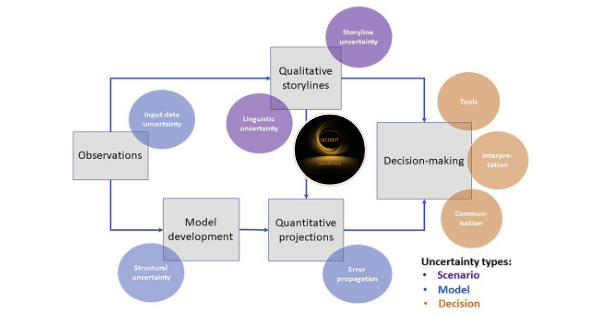
    Uncertainty as a Structural Feature, Not a Failure

    An analysis that openly states uncertainty is not weak—it is honest.

    Conversely, the absence of declared uncertainty often signals:

    • superficiality,
    • excessive simplification,
    • pressure to “deliver answers.”

    Mature intelligence integrates uncertainty into the process rather than hiding it.

    Conclusion

    Intelligence does not exist to provide certainty, because certainty, in the contexts that matter, does not exist.

    It exists to make decisions more conscious, by clarifying limits, alternatives, and consequences.

    In this sense, intelligence is not a tool for controlling the future, but for acting responsibly in the present.