
Introduction
In intelligence terminology, deception is never a simple lie. It is the deliberate construction of an alternative reality credible enough to be accepted as true by the adversary’s decision-maker. Psychological operations do not primarily target terrain or infrastructure, but the most fragile and decisive domain of conflict: the human mind.
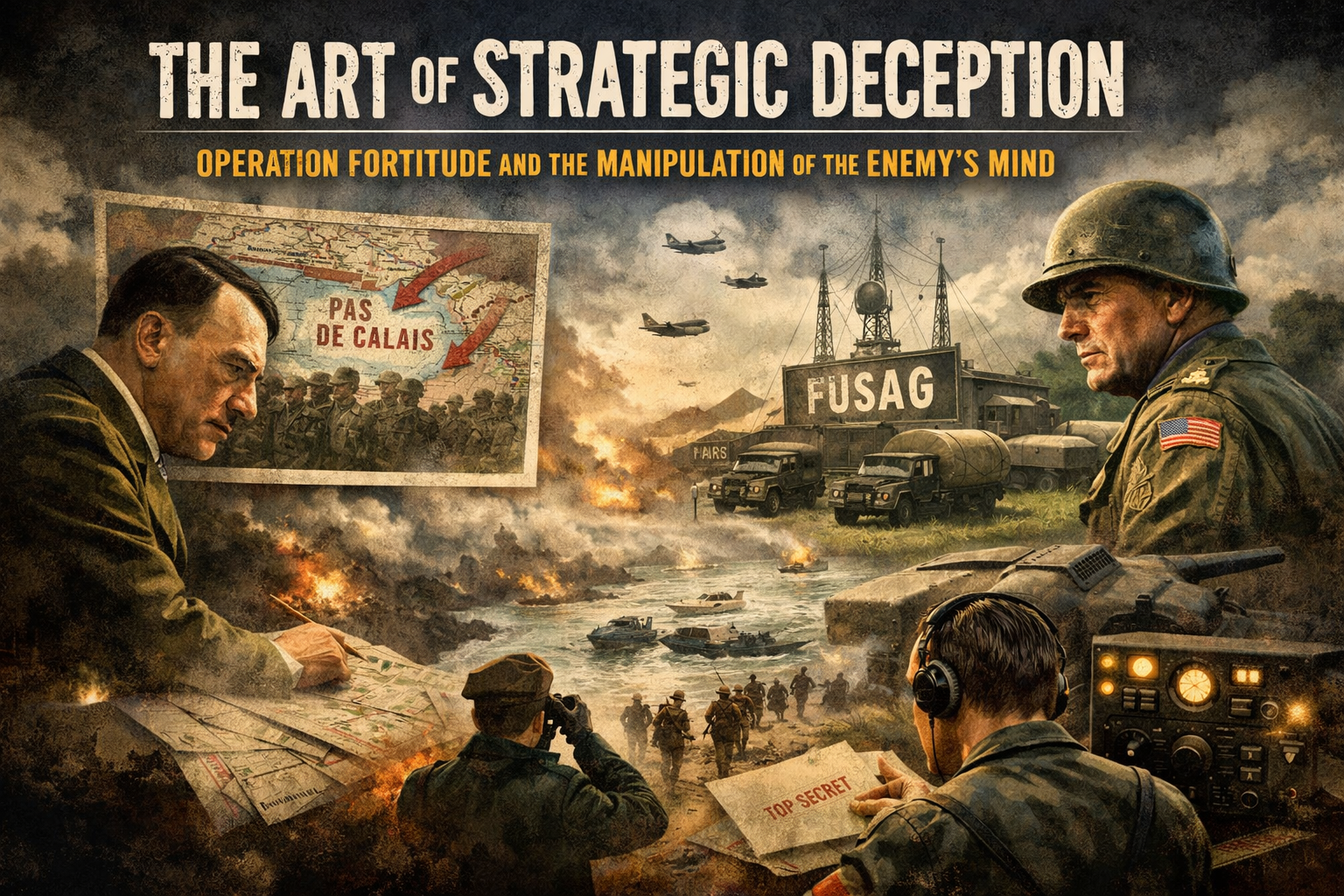
Operation Fortitude, planned by the Allies between 1943 and 1944, stands as one of the most sophisticated and well-documented examples of strategic psychological operations in modern history. Its objective was not to destroy enemy forces, but to shape the thinking of the German command, influencing expectations, assessments, and reaction times.
Fortitude demonstrates a core principle of PSYOPS: it is not necessary to convince the enemy of something entirely new; it is enough to reinforce what they are already inclined to believe.
1. Strategic context
By late 1943, a second front in Western Europe was inevitable. The German command knew it. The real question was not if, but where. Logically and geographically, the Pas-de-Calais appeared the most rational choice: shortest distance from Britain, suitable infrastructure, direct access to Germany.
Normandy seemed less favorable. This apparent logic became the foundation of the Allied deception.
2. Reinforcing expectations
Fortitude was not a single plan, but an integrated system of coordinated actions. Fortitude South aimed to convince German leadership that the main invasion would occur in the Pas-de-Calais.
The goal was not to hide Normandy, but to make Calais so credible that Normandy would be interpreted as a diversion.
3. The phantom army
The fictitious First United States Army Group (FUSAG) was a masterpiece of deception. Fake camps, inflatable equipment, artificial radio traffic, and simulated troop movements created a coherent strategic narrative.
Psychologically, it was the convergence of signals—not individual clues—that convinced the enemy.
4. Double agents and source credibility
Double agents played a decisive role. The information they transmitted was partially true, never blatantly false. In PSYOPS, source credibility often outweighs message accuracy.
5. Reputation as a psychological lever
Assigning a highly respected commander to the fictitious army reinforced plausibility. People assess truth based on coherence between roles, personalities, and expected outcomes.
6. D-Day and delayed reaction
On 6 June 1944, the German command interpreted the Normandy landings as secondary. Reserves remained idle. Time was lost. This represents the ultimate success of psychological operations.
7. Psychological analysis
Fortitude exploited confirmation bias, cognitive anchoring, doctrinal rigidity, and overconfidence. It deceived a rational, experienced adversary—not a naïve one.
8. Contemporary relevance
Modern PSYOPS no longer rely on inflatable tanks, but on dominant narratives, credible experts, and selective data. Fortitude teaches that wrong decisions often stem from comforting interpretations rather than false information.
Conclusion
Operation Fortitude proves that the mind is the first battlefield. Those who control perception often control outcomes long before physical confrontation begins.