
Tag: psyops

  • Cognitive Bias and Decisions: The Real Invisible Enemy

    Cognitive Bias and Decisions: The Real Invisible Enemy

    Introduction

    After addressing the structural limits of intelligence, it is necessary to examine another factor that profoundly affects decision quality: the functioning of the human mind itself.

    Decisions are not made in a rational vacuum. They emerge from perceptions, interpretations, and cognitive shortcuts. This is where cognitive biases operate.

    Ignoring them leads to attributing decision failures to information gaps, when the real issue is often how information is interpreted.

    What Cognitive Biases Are

    Cognitive biases are not random errors, but systematic mechanisms of human thinking.

    They help simplify reality, reduce cognitive load, and enable rapid decisions under uncertainty.

    These mechanisms are adaptive in everyday life, but become problematic when:

    • decisions are complex,
    • consequences are significant,
    • contexts are ambiguous or unstable.

    Why Competent Decision-Makers Are Not Immune

    A common misconception is that experience, intelligence, or seniority reduce bias.

    In practice, the opposite often occurs: the greater the perceived competence, the higher the risk of overconfidence.

    Biases do not primarily affect those who lack knowledge, but those who believe they know.

    This makes them particularly dangerous at higher decision-making levels.

    Intelligence as a Tool for Containment, Not Elimination

    Intelligence does not eliminate cognitive bias.

    Expecting it to do so would assign it powers it does not have.

    Its role is more realistic—and therefore more effective:

    • making implicit assumptions explicit,
    • separating facts from interpretations,
    • comparing alternative scenarios,
    • challenging dominant narratives.

    In this sense, intelligence introduces cognitive friction, slowing down decisions that appear obvious but may be flawed.

    The Risk of Self-Confirmation

    One of the most dangerous biases in decision-making is the tendency to seek information that confirms existing beliefs.

    Without analytical discipline, intelligence can be used—intentionally or not—to validate decisions already made.

    When this happens, intelligence ceases to support decisions and becomes a legitimization tool.

    Proper use of analysis requires openness to doubt and willingness to revise assumptions.

    Conclusion

    Cognitive biases are an invisible enemy because they operate below conscious awareness.

    They cannot be eliminated, but they can be recognized and contained.

    When practiced with rigor, intelligence does not make decision-makers infallible.

    It makes them more aware of their own limits.

    And it is often this awareness—more than the amount of information available—that separates fragile decisions from responsible ones.


  • OSINT: Real Capabilities and Dangerous Illusions

    OSINT: Real Capabilities and Dangerous Illusions

    Introduction

    Open Source Intelligence (OSINT) is one of the most frequently cited terms in contemporary intelligence discourse.

    The growing availability of open sources, digital tools, and analytical platforms has fostered the belief that OSINT is, by itself, a sufficient solution.

    This belief is incomplete.

    OSINT is powerful only when embedded in a rigorous analytical method. Otherwise, it risks producing noise rather than understanding.

    What OSINT Really Means

    OSINT refers to intelligence activities based on openly accessible sources: public records, media, databases, registries, social media, and online content.

    Its defining feature is not ease of access, but source traceability and the possibility of cross-verification.

    OSINT does not mean “free information” or “simple information.”

    It requires expertise, time, and critical evaluation.

    The Real Strengths of OSINT

    When used properly, OSINT can:

    • broaden the initial informational picture,
    • identify patterns and relationships,
    • confirm or challenge preliminary hypotheses,
    • reduce information asymmetry during exploratory phases.

    It is particularly effective at early stages and as a validation tool, not as a replacement for analysis.

    The Illusion of Completeness

    A common mistake is to equate abundance of sources with informational completeness.

    Open data availability can create the illusion of “seeing everything,” when in fact one is only observing what is publicly visible.

    Many relevant dynamics:

    • are not documented online,
    • are intentionally opaque,
    • emerge only through contextual and indirect interpretation.

    OSINT reveals part of the picture, not the whole.

    The Risk of Technological Overconfidence

    Advanced tools, sophisticated dashboards, and automation can reinforce a sense of control.

    But technology does not replace analytical judgment.

    Overreliance on OSINT tools without an interpretive model:

    • increases false positives,
    • amplifies existing biases,
    • produces analyses that are data-rich but conceptually weak.

    OSINT as a Means, Not an End

    OSINT is not intelligence in itself.

    It is a collection and support tool whose value depends on how it is integrated into the analytical process.

    Treating it as an end confuses information availability with decision capability.

    Treating it as a means acknowledges both its strengths and its limits.

    Conclusion

    OSINT is a valuable resource, but not a shortcut.

    It does not guarantee completeness, neutrality, or automatic correctness.

    When integrated into a serious intelligence process, it helps clarify scenarios and reduce uncertainty.

    When used without method, it risks amplifying the illusion of knowledge, one of the most dangerous conditions for decision-makers.

  • Intelligence, Risk, and the Responsibility of the Decision-Maker

    Intelligence, Risk, and the Responsibility of the Decision-Maker

    Introduction

    Every significant decision involves a degree of risk.

    Intelligence is often invoked precisely when risk becomes explicit—when choices have irreversible consequences or significant impact on people, organizations, or broader systems.

    Understanding the relationship between intelligence and risk requires a clear premise: intelligence does not reduce risk to zero, but helps make it conscious and assumable.

    Risk as a Structural Element of Decision-Making

    Risk is not an anomaly in decision-making, but a structural component.

    It exists whenever:

    • information is incomplete,
    • outcomes are not fully controllable,
    • contexts are dynamic.

    Denying risk pushes it outside reflection, making it more dangerous.

    Intelligence intervenes to bring risk into the decision, not to eliminate it.

    Intelligence and Risk Assessment

    Intelligence contributes to risk management in specific ways:

    • identifying which risks are relevant,
    • distinguishing probable risks from marginal ones,
    • clarifying conditions that may amplify or mitigate impacts.

    This does not produce “safe” choices, but better-informed choices, where risk is explicit rather than hidden.

    Responsibility Cannot Be Delegated

    A crucial point concerns the responsibility of the decision-maker.

    Relying on intelligence does not transfer responsibility to analysts.

    The final decision:

    • is not made by analysis,
    • is not justified by analysis,
    • is not absolved by analysis.

    Intelligence supports, but does not replace, the act of choice.

    Confusing these levels turns analysis into a shield rather than a tool.

    The Risk of Instrumental Use of Intelligence

    When intelligence is used to:

    • confirm decisions already taken,
    • justify unpopular choices,
    • disperse responsibility outward,

    it loses its original function.

    In such cases, analysis no longer supports better decisions—it protects decision-makers from consequences.

    Proper use of intelligence requires willingness to be exposed, not to hide.

    Decision Ethics and Analytical Transparency

    Decision-making responsibility is not only operational, but ethical.

    To decide is to accept:

    • residual uncertainty,
    • the possibility of error,
    • impact on others.

    Intelligence practiced with rigor supports this responsibility by making limits, alternatives, and costs visible.

    Conclusion

    Intelligence does not exist to eliminate risk or absolve decision-makers.

    It exists to make risk thinkable, assessable, and declarable.

    Its true value lies not in predicting the future, but in guiding decision-makers to assume responsibility for their choices with clarity and awareness.

  • Why Having Information Is Not Enough: The Paradox of Information Overload

    Why Having Information Is Not Enough: The Paradox of Information Overload

    Introduction

    We live in an era of unprecedented information availability.

    Reports, dashboards, continuous data streams, real-time updates: decision-makers have never had access to so much information.

    Yet, fragile, inconsistent, or delayed decisions are increasingly common.

    The problem is not lack of information, but ungoverned excess.

    When Information Becomes Noise

    Beyond a certain threshold, information loses decision-making value.

    Not because it is false, but because it:

    • overlaps,
    • contradicts itself,
    • lacks hierarchy.

    Under these conditions, decision-makers are not supported, but exposed to cognitive noise that obscures what truly matters.

    Information overload does not clarify—it confuses.

    The Illusion of “Knowing Enough”

    A common trap is believing that having more information automatically leads to better decisions.

    In reality, accumulation often produces:

    • decision paralysis,
    • continuous postponement,
    • dependence on ever more data that always seems insufficient.

    This creates an illusion of rigor while concealing unprocessed uncertainty.

    Cognitive Overload and the Decision-Maker

    Decision-makers are not unlimited processing systems.

    Time, attention, and synthesis capacity are finite resources.

    When information exceeds processing capacity:

    • shortcuts are used,
    • biases intensify,
    • data confirming existing beliefs is favored.

    Paradoxically, more information can lead to less reflective decisions.

    The Role of Intelligence in the Age of Abundance

    In this context, the value of intelligence shifts fundamentally.

    It is no longer about “finding information,” but about:

    • selecting what matters,
    • organizing complexity,
    • reducing information to what is decision-relevant.

    Intelligence does not add content—it removes noise.

    From Information to the Essential

    Good decisions do not require knowing everything.

    They require knowing what matters, when it matters, and in a usable form.

    This demands:

    • method,
    • synthesis,
    • acceptance of incompleteness.

    Intelligence operates precisely in this space.

    Conclusion

    Information overload is one of the least recognized yet most dangerous risks in modern decision-making.

    It does not produce ignorance, but structured confusion.

    Intelligence exists not to multiply information, but to make it usable.

    In a data-saturated world, the real skill is not knowing more, but knowing what to ignore in order to decide.

  • Intelligence and Reputational Risk: What Numbers Don’t Reveal

    Intelligence and Reputational Risk: What Numbers Don’t Reveal

    Introduction

    Reputational risk is often treated as a secondary variable, addressed only when it becomes visible.

    Until it manifests explicitly — through media crises, loss of trust, or image damage — it remains peripheral to decision-making because it resists easy measurement.

    For this very reason, reputational risk is one of the areas where intelligence demonstrates its value most clearly.

    Why Numbers Are Not Enough

    Financial indicators, operational KPIs, and performance metrics are essential tools, but they do not capture reputational dynamics.

    Reputation is built and eroded through:

    • perceptions,
    • expectations,
    • implicit narratives,
    • weak signals.

    These elements rarely appear in standard reports, yet they decisively affect organizational resilience.

    Reputational Risk as a Cumulative Phenomenon

    Reputational crises rarely stem from a single event.

    More often, they result from silent accumulation:

    • decisions that are formally correct but perceived as inconsistent,
    • legitimate choices that are poorly communicated,
    • minor behaviors that gradually shape a negative narrative.

    By the time the issue becomes visible, room for intervention is already limited.

    Weak Signals and Context

    Reputational risk initially emerges through weak signals:

    • shifts in conversational tone,
    • disproportionate reactions to marginal events,
    • recurring friction with specific stakeholders.

    Taken individually, these signals seem irrelevant.

    Viewed together, they indicate growing tension between the organization and its environment.

    Intelligence exists to connect these signals, not to measure them in isolation.

    The Role of Intelligence in Reputational Assessment

    Intelligence does not provide reputational scores or predictive formulas.

    Its contribution is different:

    • reconstructing the perceptual environment in which the organization operates,
    • identifying inconsistencies between decisions and declared values,
    • anticipating potential narrative fault lines.

    In this sense, intelligence does not quantify reputational risk — it makes it thinkable before it becomes unmanageable.

    Correct Decisions, Wrong Reputational Effects

    A common mistake is assuming that technically correct decisions automatically produce neutral or positive reputational outcomes.

    In reality, a decision may be:

    • legitimate,
    • rational,
    • aligned with objectives,

    and still be reputationally harmful if it ignores the perceptual context.

    Intelligence bridges this gap.

    Conclusion

    Reputational risk is not an “immaterial” risk, but a poorly observed one.

    It does not emerge in numbers because it first manifests in perceptions rather than metrics.

    When applied with rigor, intelligence helps intercept these signals and integrate them into decision-making.

    Not to eliminate risk, but to avoid discovering reputational damage only when it is already irreversible.

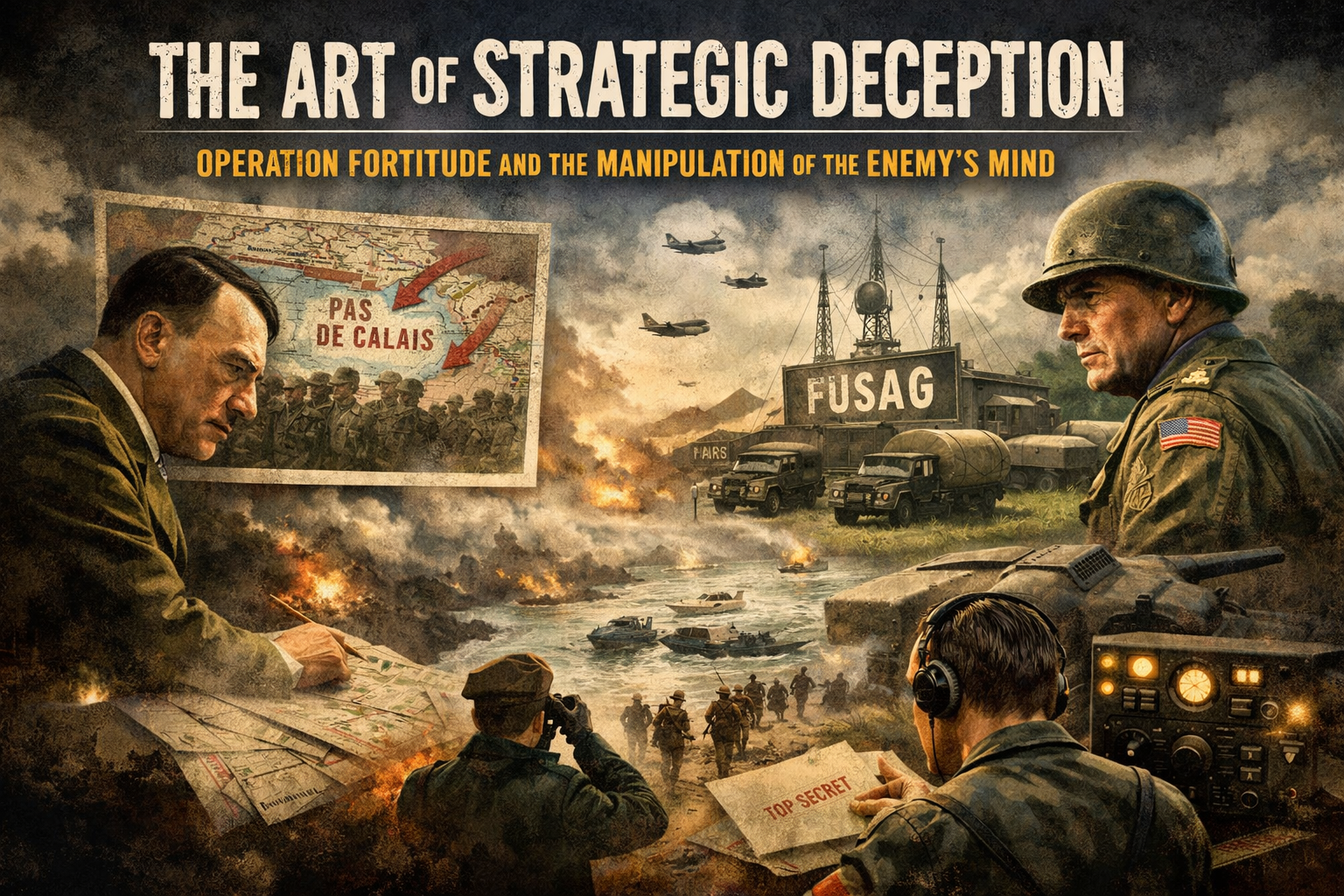
  • The Art of Strategic Deception: Operation Fortitude and the Manipulation of the Enemy’s Mind

    The Art of Strategic Deception: Operation Fortitude and the Manipulation of the Enemy’s Mind

    Introduction

    In intelligence terminology, deception is never a simple lie. It is the deliberate construction of an alternative reality credible enough to be accepted as true by the adversary’s decision-maker. Psychological operations do not primarily target terrain or infrastructure, but the most fragile and decisive domain of conflict: the human mind.

    Operation Fortitude, planned by the Allies between 1943 and 1944, stands as one of the most sophisticated and well-documented examples of strategic psychological operations in modern history. Its objective was not to destroy enemy forces, but to shape the thinking of the German command, influencing expectations, assessments, and reaction times.

    Fortitude demonstrates a core principle of PSYOPS: it is not necessary to convince the enemy of something entirely new; it is enough to reinforce what they are already inclined to believe.

    1. Strategic context

    By late 1943, a second front in Western Europe was inevitable. The German command knew it. The real question was not if, but where. Logically and geographically, the Pas-de-Calais appeared the most rational choice: shortest distance from Britain, suitable infrastructure, direct access to Germany.

    Normandy seemed less favorable. This apparent logic became the foundation of the Allied deception.

    2. Reinforcing expectations

    Fortitude was not a single plan, but an integrated system of coordinated actions. Fortitude South aimed to convince German leadership that the main invasion would occur in the Pas-de-Calais.

    The goal was not to hide Normandy, but to make Calais so credible that Normandy would be interpreted as a diversion.

    3. The phantom army

    The fictitious First United States Army Group (FUSAG) was a masterpiece of deception. Fake camps, inflatable equipment, artificial radio traffic, and simulated troop movements created a coherent strategic narrative.

    Psychologically, it was the convergence of signals—not individual clues—that convinced the enemy.

    4. Double agents and source credibility

    Double agents played a decisive role. The information they transmitted was partially true, never blatantly false. In PSYOPS, source credibility often outweighs message accuracy.

    5. Reputation as a psychological lever

    Assigning a highly respected commander to the fictitious army reinforced plausibility. People assess truth based on coherence between roles, personalities, and expected outcomes.

    6. D-Day and delayed reaction

    On 6 June 1944, the German command interpreted the Normandy landings as secondary. Reserves remained idle. Time was lost. This represents the ultimate success of psychological operations.

    7. Psychological analysis

    Fortitude exploited confirmation bias, cognitive anchoring, doctrinal rigidity, and overconfidence. It deceived a rational, experienced adversary—not a naïve one.

    8. Contemporary relevance

    Modern PSYOPS no longer rely on inflatable tanks, but on dominant narratives, credible experts, and selective data. Fortitude teaches that wrong decisions often stem from comforting interpretations rather than false information.

    Conclusion

    Operation Fortitude proves that the mind is the first battlefield. Those who control perception often control outcomes long before physical confrontation begins.