
Categoria: Metodologia, Etica e Cultura dell’Intelligence

Categoria riflessiva: metodo di lavoro, limiti dell’intelligence, etica, distinzione tra intelligence e sorveglianza, tra analisi e manipolazione.

  • When cases are not won in court: the invisible value of Strategic Intelligence for law firms

    When cases are not won in court: the invisible value of Strategic Intelligence for law firms

    Beyond technology: the structural limits of legal AI

    Reuters correctly notes that AI can:

    • process vast volumes of precedents,
    • detect decision patterns,
    • support outcome prediction,
    • accelerate case preparation.

    Yet AI does not determine strategic relevance—it identifies statistical recurrence.

    A Strategic Intelligence consultant would have addressed this limitation by shaping how, when, and why information is used.

    Strategic Intelligence in the pre-litigation phase

    One of the most underestimated areas in the Reuters analysis is the pre-litigation phase.

    Strategic Intelligence would allow a law firm to:

    • map the real interests of counterparties, beyond legal positions;
    • analyze judges’ or arbitrators’ decision-making patterns from a behavioral, not merely statistical, perspective;
    • identify leverage points before litigation even begins;
    • evaluate alternative scenarios using structured probabilistic reasoning.

    Result:

    👉 fewer unnecessary lawsuits and higher strategic selectivity.

    Decision support during proceedings

    Reuters highlights how AI increasingly assists judges and mediators.

    What remains implicit is that this reshapes the cognitive environment of decision-makers.

    A Strategic Intelligence consultant could:

    • anticipate how AI-mediated analysis influences judicial perception;
    • adapt legal arguments to decision-making logic, not only legal doctrine;
    • prevent overreliance on automated outputs;
    • frame arguments in cognitively effective ways.

    In short:

    👉 using AI as part of the cognitive battlefield, not merely a tool.

    Managing reputational and ethical risk

    The Reuters article also touches on risks related to:

    • source reliability,
    • transparency,
    • professional accountability.

    Strategic Intelligence would provide:

    • verification protocols for AI-generated insights;
    • decision-traceability frameworks;
    • safeguards against ethical and disciplinary exposure;
    • reputational risk assessments linked to automated decision-making.

    Key point:

    👉 a lost case can be recovered; lost credibility cannot.

    A real competitive advantage for law firms

    The core lesson from Reuters is clear:

    law firms that merely “use AI” do not gain lasting strategic advantage.

    Those integrating Strategic Intelligence expertise can:

    • convert data into decision superiority,
    • anticipate opposing strategies,
    • choose when litigation is truly advantageous,
    • improve outcomes without increasing legal exposure.

    Conclusion

    The Reuters article does not describe a distant future—it documents an ongoing transformation.

    The real differentiator is not possessing AI tools, but embedding them within a coherent strategic intelligence framework.

    In this context, Strategic Intelligence does not replace legal expertise; it amplifies it—

    allowing law firms to see earlier, decide better, and risk less.

    And in complex litigation, that invisible advantage often determines who truly wins.

  • When Wrong Decisions Come from Correct Information

    When Wrong Decisions Come from Correct Information

    Introduction

    In common discourse, decision failures are often attributed to incorrect or incomplete information.

    This explanation is comforting, because it points to an external and seemingly fixable cause: “the data was missing” or “the information was wrong.”

    In practice, however, many failed decisions arise from a less intuitive paradox: the information was correct, yet the decision was still wrong.

    Understanding this paradox is essential to grasp the true value of intelligence.

    Correct Information Does Not Guarantee Good Decisions

    Information may be:

    • accurate,
    • verified,
    • up to date,

    and still be decisionally inadequate.

    This happens when information is:

    • not prioritized,
    • not connected,
    • not interpreted within its context.

    Without analytical work, information remains descriptive rather than directive.

    The Problem Is Not What Is Known, but How It Is Used

    Many wrong decisions do not stem from ignorance, but from misuse of available knowledge.

    Common mechanisms include:

    • overreliance on a single indicator,
    • linear interpretation of complex phenomena,
    • drawing conclusions without considering alternatives.

    In such cases, the error is not informational, but interpretive.

    Context as the Decisive Factor

    Information is always true within a context.

    Outside that context, it can become misleading.

    Wrong decisions often arise when:

    • valid data is applied to changed scenarios,
    • past indicators are automatically projected into the future,
    • weak signals are ignored because they are not “measurable.”

    Intelligence exists precisely to re-anchor information within its operational context.

    When Internal Coherence Becomes a Trap

    Another risk lies in building decision frameworks that are internally coherent but externally fragile.

    When all information “fits,” decision-makers may develop a sense of certainty that suppresses doubt.

    In such situations:

    • alternative hypotheses are not explored,
    • divergent scenarios are not tested,
    • low-probability, high-impact events are ignored.

    The decision appears solid, but is closed in on itself.

    The Role of Intelligence

    Intelligence does not exist to provide “better” information in an absolute sense.

    It exists to:

    • put available information under tension,
    • expose latent inconsistencies,
    • reveal what information does not say.

    Its main contribution is not adding data, but preventing correct data from being used incorrectly.

    Conclusion

    Wrong decisions do not always arise from wrong information.

    They often arise from correct information used without method.

    When practiced rigorously, intelligence does not protect against error.

    It protects against the illusion that knowing something automatically means deciding well.

  • Strategic Analysis and Operational Analysis: Two Different Levels

    Strategic Analysis and Operational Analysis: Two Different Levels

    Introduction

    In organizational and managerial language, the terms strategic and operational are often used interchangeably.

    This overlap is not harmless: it reflects a conceptual confusion that, in intelligence, can undermine decision quality.

    Strategic analysis and operational analysis answer different questions, operate on different time horizons, and produce non-overlapping outputs. Understanding their distinction is essential to using intelligence correctly.

    Strategic Analysis: Long-Term Orientation

    Strategic analysis focuses on the medium to long term.

    Its purpose is not to guide immediate action, but to help decision-makers understand:

    • structural trends,
    • contextual dynamics,
    • emerging balances and imbalances,
    • possible trajectories.

    It operates at a level of orientation, not execution.

    It works with scenarios, probabilities, and alternative hypotheses, accepting uncertainty as intrinsic to its value.

    Operational Analysis: Supporting Action

    Operational analysis, by contrast, is oriented toward the short term and concrete action.

    It addresses questions such as:

    • what should be done now?
    • with which resources?
    • under which immediate risks?

    Here, detail is higher, constraints are tighter, and time is often critical.

    Operational analysis does not build long-term visions; it supports specific decisions in defined contexts.

    Why Confusing Them Is Dangerous

    Treating strategic analysis as operational leads to demands it cannot satisfy.

    Treating operational analysis as strategic leads to overgeneralizing short-term decisions.

    In both cases, the risk is the same: using a well-executed analysis for the wrong purpose.

    Complementarity Between the Two Levels

    Strategic and operational analysis are not alternatives, but complementary layers.

    The former provides the framework within which the latter gains meaning.

    The latter translates broader orientations into concrete action.

    A mature intelligence system keeps these levels distinct and manages the transition between them carefully.

    Conclusion

    Confusing strategy and operations means losing both vision and effectiveness.

    Intelligence works when it recognizes that not all decisions are of the same nature, and that different questions require different analyses.

    Conceptual clarity here is not theoretical—it is a practical condition for better decisions.

  • Cognitive Bias and Decisions: The Real Invisible Enemy

    Cognitive Bias and Decisions: The Real Invisible Enemy

    Introduction

    After addressing the structural limits of intelligence, it is necessary to examine another factor that profoundly affects decision quality: the functioning of the human mind itself.

    Decisions are not made in a rational vacuum. They emerge from perceptions, interpretations, and cognitive shortcuts. This is where cognitive biases operate.

    Ignoring them leads to attributing decision failures to information gaps, when the real issue is often how information is interpreted.

    What Cognitive Biases Are

    Cognitive biases are not random errors, but systematic mechanisms of human thinking.

    They help simplify reality, reduce cognitive load, and enable rapid decisions under uncertainty.

    These mechanisms are adaptive in everyday life, but become problematic when:

    • decisions are complex,
    • consequences are significant,
    • contexts are ambiguous or unstable.

    Why Competent Decision-Makers Are Not Immune

    A common misconception is that experience, intelligence, or seniority reduce bias.

    In practice, the opposite often occurs: the greater the perceived competence, the higher the risk of overconfidence.

    Biases do not primarily affect those who lack knowledge, but those who believe they know.

    This makes them particularly dangerous at higher decision-making levels.

    Intelligence as a Tool for Containment, Not Elimination

    Intelligence does not eliminate cognitive bias.

    Expecting it to do so would assign it powers it does not have.

    Its role is more realistic—and therefore more effective:

    • making implicit assumptions explicit,
    • separating facts from interpretations,
    • comparing alternative scenarios,
    • challenging dominant narratives.

    In this sense, intelligence introduces cognitive friction, slowing down decisions that appear obvious but may be flawed.

    The Risk of Self-Confirmation

    One of the most dangerous biases in decision-making is the tendency to seek information that confirms existing beliefs.

    Without analytical discipline, intelligence can be used—intentionally or not—to validate decisions already made.

    When this happens, intelligence ceases to support decisions and becomes a legitimization tool.

    Proper use of analysis requires openness to doubt and willingness to revise assumptions.

    Conclusion

    Cognitive biases are an invisible enemy because they operate below conscious awareness.

    They cannot be eliminated, but they can be recognized and contained.

    When practiced with rigor, intelligence does not make decision-makers infallible.

    It makes them more aware of their own limits.

    And it is often this awareness—more than the amount of information available—that separates fragile decisions from responsible ones.

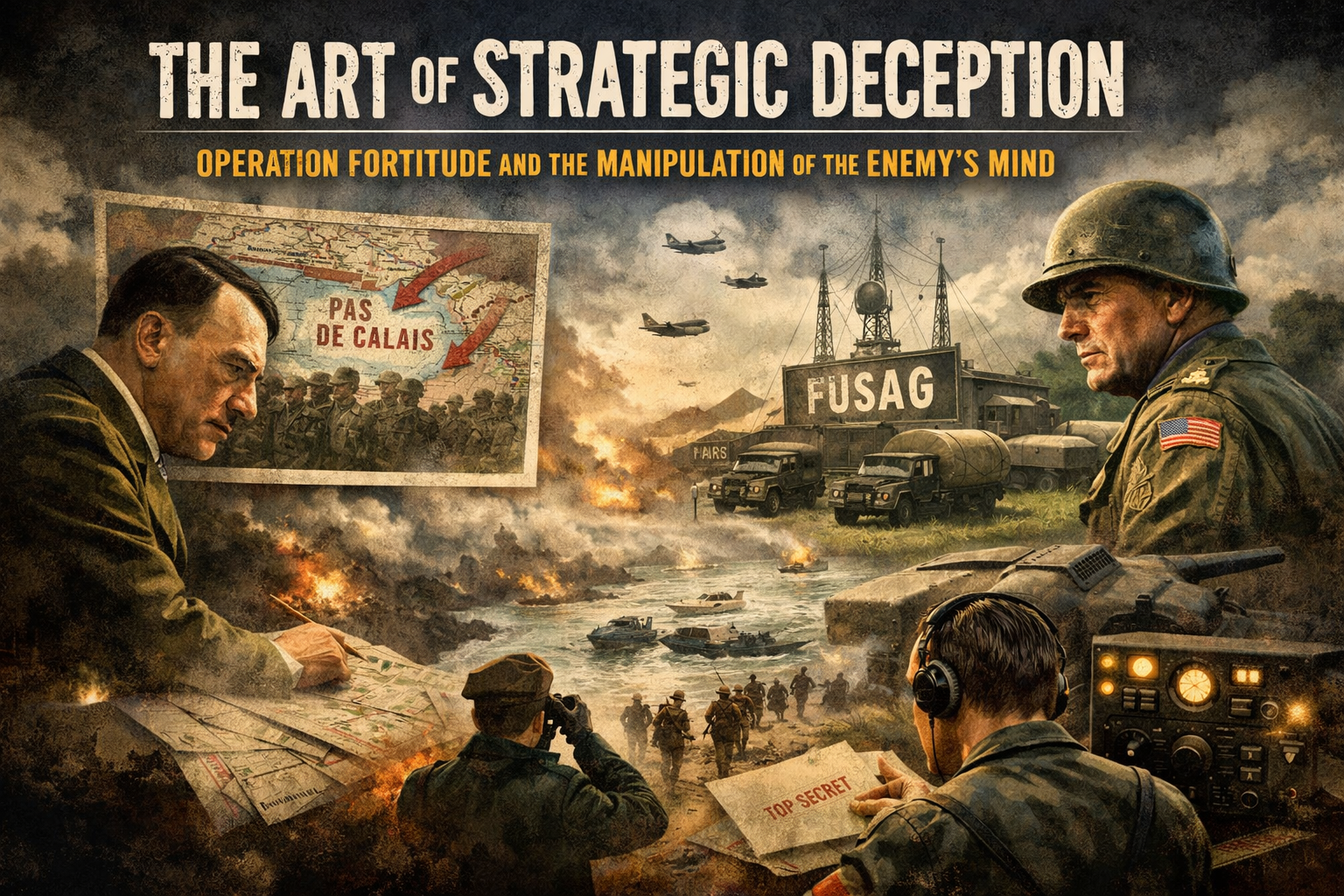
  • The Art of Strategic Deception: Operation Fortitude and the Manipulation of the Enemy’s Mind

    The Art of Strategic Deception: Operation Fortitude and the Manipulation of the Enemy’s Mind

    Introduction

    In intelligence terminology, deception is never a simple lie. It is the deliberate construction of an alternative reality credible enough to be accepted as true by the adversary’s decision-maker. Psychological operations do not primarily target terrain or infrastructure, but the most fragile and decisive domain of conflict: the human mind.

    Operation Fortitude, planned by the Allies between 1943 and 1944, stands as one of the most sophisticated and well-documented examples of strategic psychological operations in modern history. Its objective was not to destroy enemy forces, but to shape the thinking of the German command, influencing expectations, assessments, and reaction times.

    Fortitude demonstrates a core principle of PSYOPS: it is not necessary to convince the enemy of something entirely new; it is enough to reinforce what they are already inclined to believe.

    1. Strategic context

    By late 1943, a second front in Western Europe was inevitable. The German command knew it. The real question was not if, but where. Logically and geographically, the Pas-de-Calais appeared the most rational choice: shortest distance from Britain, suitable infrastructure, direct access to Germany.

    Normandy seemed less favorable. This apparent logic became the foundation of the Allied deception.

    2. Reinforcing expectations

    Fortitude was not a single plan, but an integrated system of coordinated actions. Fortitude South aimed to convince German leadership that the main invasion would occur in the Pas-de-Calais.

    The goal was not to hide Normandy, but to make Calais so credible that Normandy would be interpreted as a diversion.

    3. The phantom army

    The fictitious First United States Army Group (FUSAG) was a masterpiece of deception. Fake camps, inflatable equipment, artificial radio traffic, and simulated troop movements created a coherent strategic narrative.

    Psychologically, it was the convergence of signals—not individual clues—that convinced the enemy.

    4. Double agents and source credibility

    Double agents played a decisive role. The information they transmitted was partially true, never blatantly false. In PSYOPS, source credibility often outweighs message accuracy.

    5. Reputation as a psychological lever

    Assigning a highly respected commander to the fictitious army reinforced plausibility. People assess truth based on coherence between roles, personalities, and expected outcomes.

    6. D-Day and delayed reaction

    On 6 June 1944, the German command interpreted the Normandy landings as secondary. Reserves remained idle. Time was lost. This represents the ultimate success of psychological operations.

    7. Psychological analysis

    Fortitude exploited confirmation bias, cognitive anchoring, doctrinal rigidity, and overconfidence. It deceived a rational, experienced adversary—not a naïve one.

    8. Contemporary relevance

    Modern PSYOPS no longer rely on inflatable tanks, but on dominant narratives, credible experts, and selective data. Fortitude teaches that wrong decisions often stem from comforting interpretations rather than false information.

    Conclusion

    Operation Fortitude proves that the mind is the first battlefield. Those who control perception often control outcomes long before physical confrontation begins.