Autore: Dr. Fabrizio Vignozzi

  • The hidden cost of indecision: when not choosing is already a choice

    Introduction

    Many decision-makers tell themselves a comforting story: I haven’t decided yet because I’m still evaluating. It sounds responsible, even wise. Yet behind this narrative lies an uncomfortable truth: every non-decision produces real effects.

    My work begins when time becomes critical and no one dares to say it openly. Intelligence does not push for impulsive action; it anchors decisions to responsibility. Because the real danger is not deciding too early, but deciding too late without realizing it.

    Indecision as a Passive Strategy

    In many organizations, indecision is rewarded. Postponement avoids visible mistakes, shifts responsibility to circumstances, and waits for events to decide. It is a passive strategy with short-term benefits.

    Over time, however, it causes silent damage:

    – loss of initiative,

    – erosion of internal trust,

    – increased exposure to external shocks.

    Intelligence has always treated time as a decisive variable. Sherman Kent warned that perfect information arriving too late is strategically useless. The same applies to decisions: quality without timing is refined inefficiency.

    Time as a Risk Factor

    In my approach, time is not neutral. It is a risk multiplier. Every day of delay alters the context, shifts balances, and changes actors’ intentions.

    Decision-makers often discover, with discomfort, that what once was a solid analysis becomes obsolete. Not because it was wrong, but because reality did not wait. This realization generates a distinct form of anger: understanding that waiting was not neutral, but actively destructive.

    This is where interest grows in a method that does not merely analyze, but integrates time into decision-making.

    How I Intervene on Indecision

    I do not force decisions. I make the cost of delay visible. When that cost is clear, decisions cease to be emotional and become rational.

    Operationally, I work along three lines:

    1. Analyzing the consequences of not deciding – what happens if nothing changes.
    2. Defining decision windows – when a choice still matters.
    3. Clarifying responsibility – who bears the cost of waiting.

    This restores control over time. Not by rushing, but by choosing the moment consciously. It is a decisive shift that gives strategic dignity back to action.

    From Fear of Error to Responsibility for Choice

    Many delays stem from a legitimate fear: making mistakes. Intelligence reveals an uncomfortable truth: not choosing often carries greater risk than an imperfect choice.

    When method replaces hesitation, an internal transformation occurs. Fear gives way to mature responsibility—the awareness that every choice has a cost, but that the cost of inaction is almost always higher.

    What emerges is a deep sense of relief. Not excitement. Relief. The relief of no longer being hostage to time, but able to inhabit it.

    Conclusion

    Indecision is not the absence of choice. It is a choice operating in the shadows. My work brings it into the open—measurable, discussable, governable.

    Those who integrate intelligence into their decision process discover that time ceases to be an enemy and becomes a strategic variable. And when time returns as a resource, decisions stop weighing down and start sustaining action.


  • Cognitive Bias and Decisions: The Real Invisible Enemy

    Cognitive Bias and Decisions: The Real Invisible Enemy

    Introduction

    After addressing the structural limits of intelligence, it is necessary to examine another factor that profoundly affects decision quality: the functioning of the human mind itself.

    Decisions are not made in a rational vacuum. They emerge from perceptions, interpretations, and cognitive shortcuts. This is where cognitive biases operate.

    Ignoring them leads to attributing decision failures to information gaps, when the real issue is often how information is interpreted.

    What Cognitive Biases Are

    Cognitive biases are not random errors, but systematic mechanisms of human thinking.

    They help simplify reality, reduce cognitive load, and enable rapid decisions under uncertainty.

    These mechanisms are adaptive in everyday life, but become problematic when:

    • decisions are complex,
    • consequences are significant,
    • contexts are ambiguous or unstable.

    Why Competent Decision-Makers Are Not Immune

    A common misconception is that experience, intelligence, or seniority reduce bias.

    In practice, the opposite often occurs: the greater the perceived competence, the higher the risk of overconfidence.

    Biases do not primarily affect those who lack knowledge, but those who believe they know.

    This makes them particularly dangerous at higher decision-making levels.

    Intelligence as a Tool for Containment, Not Elimination

    Intelligence does not eliminate cognitive bias.

    Expecting it to do so would assign it powers it does not have.

    Its role is more realistic—and therefore more effective:

    • making implicit assumptions explicit,
    • separating facts from interpretations,
    • comparing alternative scenarios,
    • challenging dominant narratives.

    In this sense, intelligence introduces cognitive friction, slowing down decisions that appear obvious but may be flawed.

    The Risk of Self-Confirmation

    One of the most dangerous biases in decision-making is the tendency to seek information that confirms existing beliefs.

    Without analytical discipline, intelligence can be used—intentionally or not—to validate decisions already made.

    When this happens, intelligence ceases to support decisions and becomes a legitimization tool.

    Proper use of analysis requires openness to doubt and willingness to revise assumptions.

    Conclusion

    Cognitive biases are an invisible enemy because they operate below conscious awareness.

    They cannot be eliminated, but they can be recognized and contained.

    When practiced with rigor, intelligence does not make decision-makers infallible.

    It makes them more aware of their own limits.

    And it is often this awareness—more than the amount of information available—that separates fragile decisions from responsible ones.

  • OSINT: Real Capabilities and Dangerous Illusions

    OSINT: Real Capabilities and Dangerous Illusions

    Introduction

    Open Source Intelligence (OSINT) is one of the most frequently cited terms in contemporary intelligence discourse.

    The growing availability of open sources, digital tools, and analytical platforms has fostered the belief that OSINT is, by itself, a sufficient solution.

    This belief is incomplete.

    OSINT is powerful only when embedded in a rigorous analytical method. Otherwise, it risks producing noise rather than understanding.

    What OSINT Really Means

    OSINT refers to intelligence activities based on openly accessible sources: public records, media, databases, registries, social media, and online content.

    Its defining feature is not ease of access, but source traceability and the possibility of cross-verification.

    OSINT does not mean “free information” or “simple information.”

    It requires expertise, time, and critical evaluation.

    The Real Strengths of OSINT

    When used properly, OSINT can:

    • broaden the initial informational picture,
    • identify patterns and relationships,
    • confirm or challenge preliminary hypotheses,
    • reduce information asymmetry during exploratory phases.

    It is particularly effective at early stages and as a validation tool, not as a replacement for analysis.

    The Illusion of Completeness

    A common mistake is to equate abundance of sources with informational completeness.

    Open data availability can create the illusion of “seeing everything,” when in fact one is only observing what is publicly visible.

    Many relevant dynamics:

    • are not documented online,
    • are intentionally opaque,
    • emerge only through contextual and indirect interpretation.

    OSINT reveals part of the picture, not the whole.

    The Risk of Technological Overconfidence

    Advanced tools, sophisticated dashboards, and automation can reinforce a sense of control.

    But technology does not replace analytical judgment.

    Overreliance on OSINT tools without an interpretive model:

    • increases false positives,
    • amplifies existing biases,
    • produces analyses that are data-rich but conceptually weak.

    OSINT as a Means, Not an End

    OSINT is not intelligence in itself.

    It is a collection and support tool whose value depends on how it is integrated into the analytical process.

    Treating it as an end confuses information availability with decision capability.

    Treating it as a means acknowledges both its strengths and its limits.

    Conclusion

    OSINT is a valuable resource, but not a shortcut.

    It does not guarantee completeness, neutrality, or automatic correctness.

    When integrated into a serious intelligence process, it helps clarify scenarios and reduce uncertainty.

    When used without method, it risks amplifying the illusion of knowledge, one of the most dangerous conditions for decision-makers.

  • Thinking in scenarios: deciding today without being surprised tomorrow

    Thinking in scenarios: deciding today without being surprised tomorrow

    Introduction

    The future does not betray decisions. Decisions betray the future when they imagine it as linear.

    Most decision-makers—experienced ones included—build choices on a silent assumption: things will continue more or less as they are. It is comforting, but fragile.

    My work addresses this fragility. Intelligence does not offer perfect forecasts; it builds decision resilience. Resilience emerges when a choice is designed to hold across multiple possible developments, not just one.

    The Myth of Prediction

    Intelligence is often confused with prediction. This is a conceptual mistake. Prediction guesses; intelligence prepares.

    The analytical tradition initiated by Sherman Kent clarified that intelligence does not state what will happen, but helps decision-makers understand what might happen and with what implications.

    This realization often generates frustration for past decisions built on a single future. It is productive frustration—it signals the need for a stronger method.

    Scenarios as Instruments of Clarity

    A scenario is not a story. It is a structure of possibilities designed to explore how variables may combine into different outcomes.

    In my practice, scenario thinking serves three critical functions:

    – breaking linear reasoning,

    – reducing surprise effects,

    – protecting decisions from contextual shifts.

    Decision-makers often recognize, with retrospective anger, that so-called “unpredictable” events were actually unconsidered, not unimaginable. This awareness fuels curiosity: what would have changed if I had thought in scenarios?

    Chapter 3 – How I Build Decision Scenarios

    My approach does not generate endless hypotheses. I build a limited number of relevant scenarios—those that truly stress-test the decision.

    Operationally, I follow four steps:

    1. Identifying critical variables – elements that truly alter outcomes.
    2. Controlled combination of variables – avoiding speculation.
    3. Impact assessment on the decision – what holds, what breaks.
    4. Decision adaptation – making the choice valid across contexts.

    When done well, this produces strategic calm. Not because the future is known, but because it is no longer threatening.

    Deciding Without Depending on the Future

    The real advantage of scenario thinking is autonomy. A decision designed for multiple scenarios does not rely on a single outcome to remain valid.

    This yields concrete benefits:

    – greater temporal stability,

    – fewer emergency corrections,

    – increased stakeholder credibility,

    – reduced anticipatory anxiety.

    A quiet form of joy emerges: knowing that whatever happens, preparation is already in place.

    Conclusion

    Thinking in scenarios does not mean living in uncertainty. It means inhabiting uncertainty without being dominated by it. My work transforms the future from an undefined threat into a space of governable possibilities.

    When a decision is designed for multiple possible worlds, it needs no defense. It endures—because it was built to last.

  • Decision accountability: why power weighs only when it is real

    Introduction

    “Accountability” is often invoked as an abstract value. In reality, it is concrete, measurable, and frequently avoided. Many decision-makers seek control; few accept full accountability. The difference is decisive: control tries to prevent error, accountability accepts error as a possible cost of conscious choice.

    My work operates precisely at this transition. Intelligence does not inflate the decision-maker’s ego; it strengthens their capacity to sustain. When accountability is structured, power ceases to be an emotional burden and becomes a governable function.

    Role, Power, Accountability: A Common Confusion

    In many organizations, role is mistaken for accountability. Executives “decide” but do not always truly answer for consequences. This dissociation produces defensive choices, strategic delays, and opaque delegation.

    Intelligence theory has long distinguished formal authority from effective accountability. Sherman Kent emphasized that analysis has value only when someone is willing to use it and assume the risk. Without that assumption, even excellent intelligence remains harmless.

    A first uncomfortable realization often emerges: having decided without truly exposing oneself. It generates resistance—and openness.

    Accountability as Structure, Not Virtue

    Accountability is not a moral trait. It is a decision structure. When absent, decision-makers seek protection: redundant procedures, multiple opinions, diluted consensus. When present, they seek clarity.

    In my approach, accountability is operationalized through three elements:

    clear decision boundaries,

    explicit consequence scenarios,

    risk acceptability criteria.

    This often triggers retrospective anger: “I could have decided earlier if I had seen it this way.” It is not sterile regret. It is the discovery that accountability weighs less when anticipated and structured.

    How I Work on Decision Accountability

    I never ask decision-makers to “take more responsibility.” Instead, I create conditions where accountability becomes inevitable yet sustainable.

    Operationally, I act on three levels:

    1. Making consequences explicit – what happens in each plausible scenario.
    2. Reducing ambiguity – what is not decided is an implicit choice.
    3. Aligning decision and identity – who you are when you choose.

    When these are clear, a shift occurs: defense gives way to governance. Decisions become positions, not reactions.


    The Invisible Benefit: Authority Without Rigidity

    Well-structured accountability generates authority—not imposed, but recognized. People follow those who bear consequences, not those who hide behind process.

    Concrete outcomes follow:

    – increased internal trust,

    – reduced latent conflict,

    – faster decisions without impulsivity,

    – greater strategic stability.

    A new sensation emerges: solidity. Not excitement. Solidity—the ability to hold what one decides.

    Conclusion

    Decision accountability is not declared. It is built. My work provides that construction: making explicit what is usually implicit, measuring what is avoided, anticipating what would otherwise erupt later.

    When accountability is real, power stops weighing down. And when power no longer weighs, decisions finally become inhabitable.

  • Inducing Surrender: Psychological Operations during the Gulf War (1990–1991)

    Inducing Surrender: Psychological Operations during the Gulf War (1990–1991)

    Introduction

    In the study of psychological operations, the 1990–1991 Gulf War represents a quiet but decisive turning point. Not because of technological innovation alone, but because tens of thousands of Iraqi soldiers surrendered without fighting, convinced that resistance was pointless, dangerous, or irrational.

    This mass surrender was not a spontaneous reaction to military superiority. It was the result of a systematic psychological campaign, integrated with military operations and aimed at the most vulnerable element of the Iraqi forces: the will to fight.

    1. Strategic context

    In August 1990, Iraq invaded Kuwait. A UN-mandated coalition formed rapidly. On paper, Iraqi forces appeared strong. In reality, morale was fragile, leadership distrusted, and fear widespread.

    PSYOPS were designed to amplify existing weaknesses, not fabricate new ones.

    2. Psychological objective

    The goal was not terror, but persuasion through rational fear. Soldiers were encouraged to view surrender as the safest and most logical choice.

    This marks a shift from propaganda to decision engineering.

    3. Leaflets

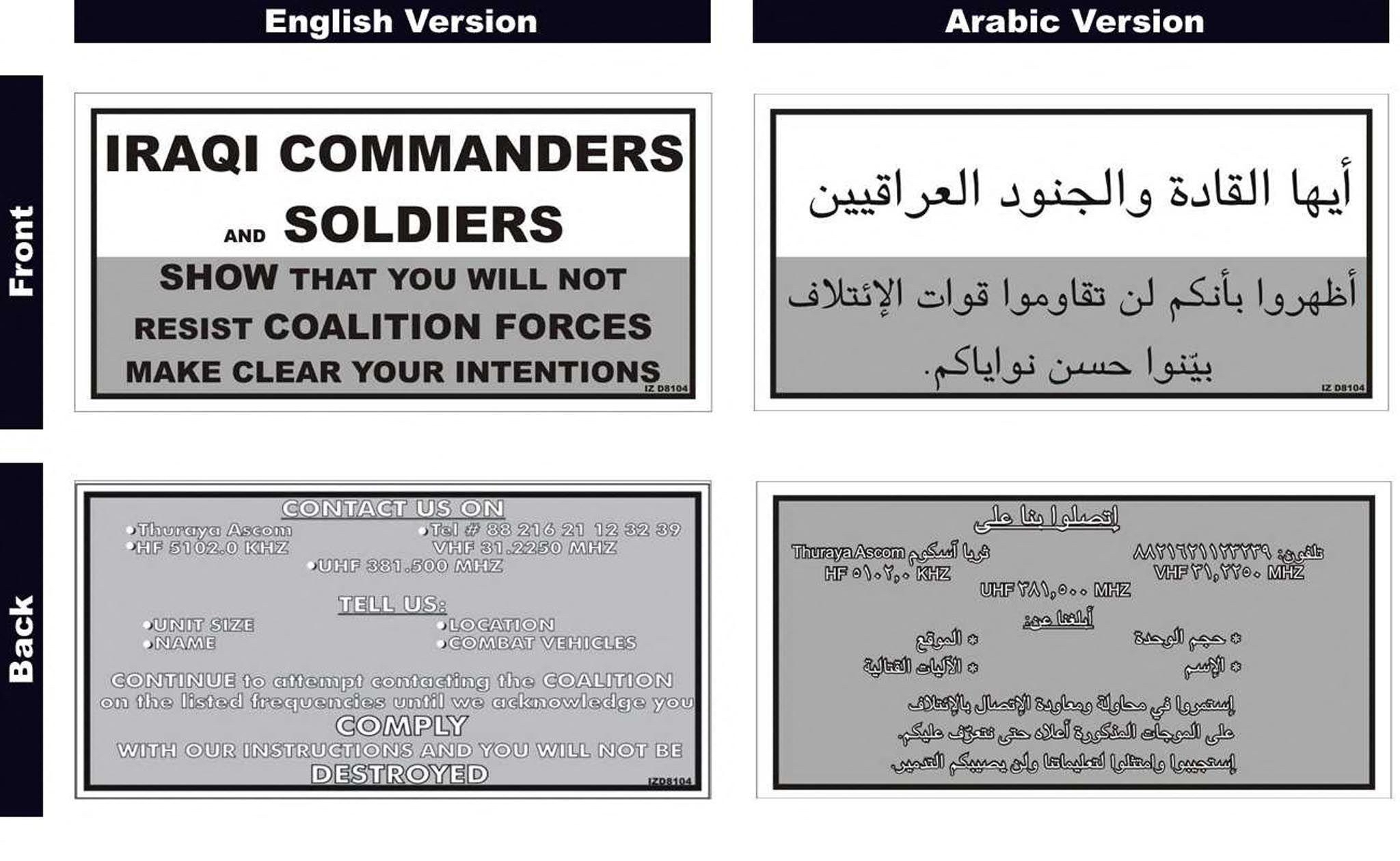
    Millions of leaflets were dropped, offering clear instructions on surrender, reassurance about treatment, and warnings of impending strikes.

    Psychologically, they provided predictability, perceived control, and reduced uncertainty.

    4. Radio broadcasts

    Radio messaging reinforced battlefield realities, undermining regime credibility and creating cognitive isolation.

    When enemy messages align with observed reality, resistance collapses.

    5. Technological dominance and perception

    Precision strikes created a sense of omnipresence and helplessness. Soldiers felt there was no safe place.

    6. Behavioral contagion

    As surrender proved safe, it spread rapidly. Behavior became socially validated.

    7. Psychological analysis

    Gulf War PSYOPS leveraged loss aversion, fear, conformity, and distrust in leadership. Soldiers faced an asymmetrical choice where fighting seemed irrational.

    8. Results

    Tens of thousands surrendered. Ground combat was brief. Coalition casualties were minimized.

    This is the highest achievement of PSYOPS: victory without direct confrontation.

    Conclusion

    The Gulf War shows that true superiority lies in shaping perception and decision-making. When the mind yields, the battlefield follows.

  • The Art of Strategic Deception: Operation Fortitude and the Manipulation of the Enemy’s Mind

    The Art of Strategic Deception: Operation Fortitude and the Manipulation of the Enemy’s Mind

    Introduction

    In intelligence terminology, deception is never a simple lie. It is the deliberate construction of an alternative reality credible enough to be accepted as true by the adversary’s decision-maker. Psychological operations do not primarily target terrain or infrastructure, but the most fragile and decisive domain of conflict: the human mind.

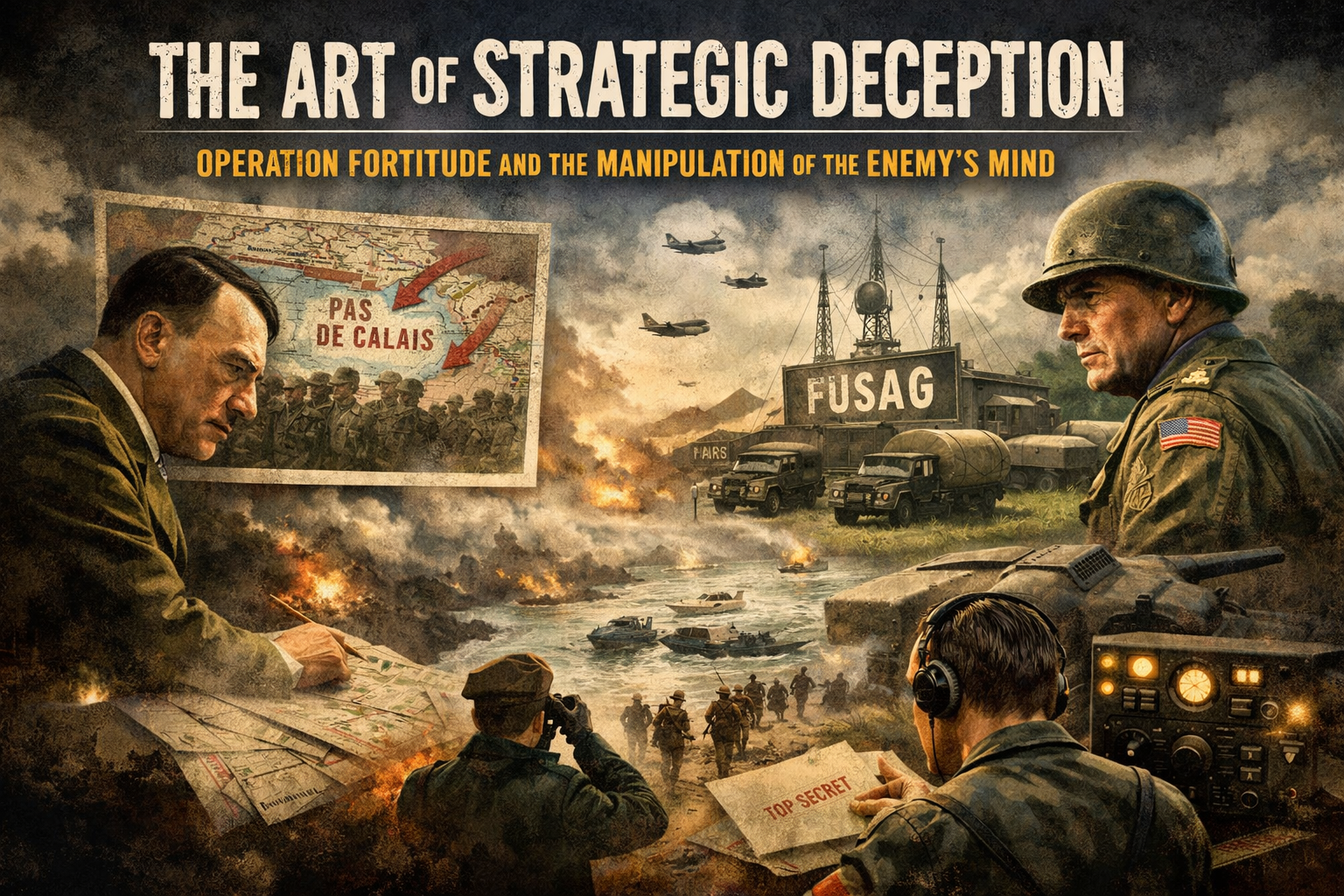
    Operation Fortitude, planned by the Allies between 1943 and 1944, stands as one of the most sophisticated and well-documented examples of strategic psychological operations in modern history. Its objective was not to destroy enemy forces, but to shape the thinking of the German command, influencing expectations, assessments, and reaction times.

    Fortitude demonstrates a core principle of PSYOPS: it is not necessary to convince the enemy of something entirely new; it is enough to reinforce what they are already inclined to believe.

    1. Strategic context

    By late 1943, a second front in Western Europe was inevitable. The German command knew it. The real question was not if, but where. Logically and geographically, the Pas-de-Calais appeared the most rational choice: shortest distance from Britain, suitable infrastructure, direct access to Germany.

    Normandy seemed less favorable. This apparent logic became the foundation of the Allied deception.

    2. Reinforcing expectations

    Fortitude was not a single plan, but an integrated system of coordinated actions. Fortitude South aimed to convince German leadership that the main invasion would occur in the Pas-de-Calais.

    The goal was not to hide Normandy, but to make Calais so credible that Normandy would be interpreted as a diversion.

    3. The phantom army

    The fictitious First United States Army Group (FUSAG) was a masterpiece of deception. Fake camps, inflatable equipment, artificial radio traffic, and simulated troop movements created a coherent strategic narrative.

    Psychologically, it was the convergence of signals—not individual clues—that convinced the enemy.

    4. Double agents and source credibility

    Double agents played a decisive role. The information they transmitted was partially true, never blatantly false. In PSYOPS, source credibility often outweighs message accuracy.

    5. Reputation as a psychological lever

    Assigning a highly respected commander to the fictitious army reinforced plausibility. People assess truth based on coherence between roles, personalities, and expected outcomes.

    6. D-Day and delayed reaction

    On 6 June 1944, the German command interpreted the Normandy landings as secondary. Reserves remained idle. Time was lost. This represents the ultimate success of psychological operations.

    7. Psychological analysis

    Fortitude exploited confirmation bias, cognitive anchoring, doctrinal rigidity, and overconfidence. It deceived a rational, experienced adversary—not a naïve one.

    8. Contemporary relevance

    Modern PSYOPS no longer rely on inflatable tanks, but on dominant narratives, credible experts, and selective data. Fortitude teaches that wrong decisions often stem from comforting interpretations rather than false information.

    Conclusion

    Operation Fortitude proves that the mind is the first battlefield. Those who control perception often control outcomes long before physical confrontation begins.

  • Fear in the Language of Culture: Psychological Operations in Vietnam and the “Ghost Tape No. 10” Case

    Fear in the Language of Culture: Psychological Operations in Vietnam and the “Ghost Tape No. 10” Case

    Introduction

    If Operation Fortitude represents rational deception and the Gulf War exemplifies persuasion through survival, the Vietnam War exposes the most ambiguous side of psychological operations.

    “Ghost Tape No. 10” stands as a documented and controversial case where cultural fear became the primary psychological lever.

    1. Context: a war without a front

    Vietnam was an asymmetric conflict, culturally distant from Western frameworks. PSYOPS were seen as a way to reduce direct confrontation.

    2. Cultural fear

    Some Vietnamese beliefs held that souls of the unburied dead would wander eternally. This belief became the foundation of the operation.

    Understanding a belief, however, does not mean understanding its depth.

    3. Operation description

    Night-time broadcasts simulated voices of wandering spirits, urging fighters to stop. Sound design amplified emotional impact.

    4. Psychological assumptions

    The operation assumed fear would override ideology. This proved overly simplistic.

    5. Field effects

    Initial surprise quickly faded. In some cases, the operation strengthened enemy cohesion.

    6. Psychological analysis

    Fear must be credible, coherent, and inescapable. In Vietnam, resilience and ideology prevailed.

    7. Ethical and cultural issues

    Using sacred symbols as tools carries serious ethical and strategic risks.

    8. Lessons learned

    Effective PSYOPS require anthropological depth, not cultural shortcuts.

    Conclusion

    “Ghost Tape No. 10” reminds us that the mind is not a programmable system. When fear is misunderstood, psychological operations fail.

  • Intelligence and Reputational Risk: What Numbers Don’t Reveal

    Intelligence and Reputational Risk: What Numbers Don’t Reveal

    Introduction

    Reputational risk is often treated as a secondary variable, addressed only when it becomes visible.

    Until it manifests explicitly — through media crises, loss of trust, or image damage — it remains peripheral to decision-making because it resists easy measurement.

    For this very reason, reputational risk is one of the areas where intelligence demonstrates its value most clearly.

    Why Numbers Are Not Enough

    Financial indicators, operational KPIs, and performance metrics are essential tools, but they do not capture reputational dynamics.

    Reputation is built and eroded through:

    • perceptions,
    • expectations,
    • implicit narratives,
    • weak signals.

    These elements rarely appear in standard reports, yet they decisively affect organizational resilience.

    Reputational Risk as a Cumulative Phenomenon

    Reputational crises rarely stem from a single event.

    More often, they result from silent accumulation:

    • decisions that are formally correct but perceived as inconsistent,
    • legitimate choices that are poorly communicated,
    • minor behaviors that gradually shape a negative narrative.

    By the time the issue becomes visible, room for intervention is already limited.

    Weak Signals and Context

    Reputational risk initially emerges through weak signals:

    • shifts in conversational tone,
    • disproportionate reactions to marginal events,
    • recurring friction with specific stakeholders.

    Taken individually, these signals seem irrelevant.

    Viewed together, they indicate growing tension between the organization and its environment.

    Intelligence exists to connect these signals, not to measure them in isolation.

    The Role of Intelligence in Reputational Assessment

    Intelligence does not provide reputational scores or predictive formulas.

    Its contribution is different:

    • reconstructing the perceptual environment in which the organization operates,
    • identifying inconsistencies between decisions and declared values,
    • anticipating potential narrative fault lines.

    In this sense, intelligence does not quantify reputational risk — it makes it thinkable before it becomes unmanageable.

    Correct Decisions, Wrong Reputational Effects

    A common mistake is assuming that technically correct decisions automatically produce neutral or positive reputational outcomes.

    In reality, a decision may be:

    • legitimate,
    • rational,
    • aligned with objectives,

    and still be reputationally harmful if it ignores the perceptual context.

    Intelligence bridges this gap.

    Conclusion

    Reputational risk is not an “immaterial” risk, but a poorly observed one.

    It does not emerge in numbers because it first manifests in perceptions rather than metrics.

    When applied with rigor, intelligence helps intercept these signals and integrate them into decision-making.

    Not to eliminate risk, but to avoid discovering reputational damage only when it is already irreversible.

  • Why Having Information Is Not Enough: The Paradox of Information Overload

    Why Having Information Is Not Enough: The Paradox of Information Overload

    Introduction

    We live in an era of unprecedented information availability.

    Reports, dashboards, continuous data streams, real-time updates: decision-makers have never had access to so much information.

    Yet, fragile, inconsistent, or delayed decisions are increasingly common.

    The problem is not lack of information, but ungoverned excess.

    When Information Becomes Noise

    Beyond a certain threshold, information loses decision-making value.

    Not because it is false, but because it:

    • overlaps,
    • contradicts itself,
    • lacks hierarchy.

    Under these conditions, decision-makers are not supported, but exposed to cognitive noise that obscures what truly matters.

    Information overload does not clarify—it confuses.

    The Illusion of “Knowing Enough”

    A common trap is believing that having more information automatically leads to better decisions.

    In reality, accumulation often produces:

    • decision paralysis,
    • continuous postponement,
    • dependence on ever more data that always seems insufficient.

    This creates an illusion of rigor while concealing unprocessed uncertainty.

    Cognitive Overload and the Decision-Maker

    Decision-makers are not unlimited processing systems.

    Time, attention, and synthesis capacity are finite resources.

    When information exceeds processing capacity:

    • shortcuts are used,
    • biases intensify,
    • data confirming existing beliefs is favored.

    Paradoxically, more information can lead to less reflective decisions.

    The Role of Intelligence in the Age of Abundance

    In this context, the value of intelligence shifts fundamentally.

    It is no longer about “finding information,” but about:

    • selecting what matters,
    • organizing complexity,
    • reducing information to what is decision-relevant.

    Intelligence does not add content—it removes noise.

    From Information to the Essential

    Good decisions do not require knowing everything.

    They require knowing what matters, when it matters, and in a usable form.

    This demands:

    • method,
    • synthesis,
    • acceptance of incompleteness.

    Intelligence operates precisely in this space.

    Conclusion

    Information overload is one of the least recognized yet most dangerous risks in modern decision-making.

    It does not produce ignorance, but structured confusion.

    Intelligence exists not to multiply information, but to make it usable.

    In a data-saturated world, the real skill is not knowing more, but knowing what to ignore in order to decide.

  • Intelligence, Risk, and the Responsibility of the Decision-Maker

    Intelligence, Risk, and the Responsibility of the Decision-Maker

    Introduction

    Every significant decision involves a degree of risk.

    Intelligence is often invoked precisely when risk becomes explicit—when choices have irreversible consequences or significant impact on people, organizations, or broader systems.

    Understanding the relationship between intelligence and risk requires a clear premise: intelligence does not reduce risk to zero, but helps make it conscious and assumable.

    Risk as a Structural Element of Decision-Making

    Risk is not an anomaly in decision-making, but a structural component.

    It exists whenever:

    • information is incomplete,
    • outcomes are not fully controllable,
    • contexts are dynamic.

    Denying risk pushes it outside reflection, making it more dangerous.

    Intelligence intervenes to bring risk into the decision, not to eliminate it.

    Intelligence and Risk Assessment

    Intelligence contributes to risk management in specific ways:

    • identifying which risks are relevant,
    • distinguishing probable risks from marginal ones,
    • clarifying conditions that may amplify or mitigate impacts.

    This does not produce “safe” choices, but better-informed choices, where risk is explicit rather than hidden.

    Responsibility Cannot Be Delegated

    A crucial point concerns the responsibility of the decision-maker.

    Relying on intelligence does not transfer responsibility to analysts.

    The final decision:

    • is not made by analysis,
    • is not justified by analysis,
    • is not absolved by analysis.

    Intelligence supports, but does not replace, the act of choice.

    Confusing these levels turns analysis into a shield rather than a tool.

    The Risk of Instrumental Use of Intelligence

    When intelligence is used to:

    • confirm decisions already taken,
    • justify unpopular choices,
    • disperse responsibility outward,

    it loses its original function.

    In such cases, analysis no longer supports better decisions—it protects decision-makers from consequences.

    Proper use of intelligence requires willingness to be exposed, not to hide.

    Decision Ethics and Analytical Transparency

    Decision-making responsibility is not only operational, but ethical.

    To decide is to accept:

    • residual uncertainty,
    • the possibility of error,
    • impact on others.

    Intelligence practiced with rigor supports this responsibility by making limits, alternatives, and costs visible.

    Conclusion

    Intelligence does not exist to eliminate risk or absolve decision-makers.

    It exists to make risk thinkable, assessable, and declarable.

    Its true value lies not in predicting the future, but in guiding decision-makers to assume responsibility for their choices with clarity and awareness.

  • Обзор онлайн казино Вавада для азартных игроков


    Обзор казино Вавада для азартных игроков


    Обзор онлайн казино Вавада для азартных игроков

    Если хотите получить качественный опыт в онлайн-развлечениях, стоит обратить внимание на платформу, которая предлагает разнообразные слоты, настольные соревнования и живые игры. Здесь множество опций для тех, кто ищет новые вызовы и отличные выигрыши. Есть возможность не только наслаждаться игрой, но и участвовать в увлекательных турнирах с хорошими призами.

    Попробуйте свои силы в игровых автоматах, где можно найти множество тем и механик. Это идеальное место, чтобы обострить свои навыки и испытать удачу. Для любителей классических настольных игр также предусмотрены специальные разделы с рулеткой, покером и блэкджеком. А если хотите ощутить атмосферу настоящего игорного заведения, обратите внимание на раздел с живыми дилерами.

    Не упустите шанс посетить вавада казино официальный сайт, где можно узнать о доступных бонусах и акциях, которые делают игру ещё более интересной. Поддержка пользователей на простом и доступном уровне всегда готова помочь с любыми вопросами. Варанивайте свои стратегии и получайте удовольствие от процесса!

    Регистрация и создание аккаунта в Вавада

    Для регистрации в платформе просто перейдите на главный сайт и найдите кнопку “Регистрация”. Она обычно заметно выделяется. Щелкните по ней и заполните форму, указав ваши персональные данные: имя, электронную почту, номер телефона и пароль. Убедитесь, что информация корректна, иначе могут возникнуть проблемы с подтверждением аккаунта.

    Особое внимание стоит обратить на создание надежного пароля. Выбирайте комбинацию из букв, цифр и символов, чтобы усилить защиту профиля. После заполнения всех полей нажмите кнопку “Зарегистрироваться”. Вы получите письмо с подтверждением – перейдите по ссылке из него, чтобы активировать аккаунт. Если письма не пришло, проверьте спам.

    Шаг Описание
    1 Перейдите на сайт и нажмите “Регистрация”.
    2 Заполните форму с личными данными.
    3 Создайте надежный пароль и подтвердите почту.

    Обзор игровых автоматов и бонусных предложений

    В этом игровом пространстве вы встретите впечатляющее количество автоматов с разнообразными сюжетами и механиками. Выбор от классических фруктовых машин до современных слотов с 3D-графикой и уникальными бонусами – все доступно на одном сайте. Рекомендуется обратить внимание на видео-слоты с прогрессивными джекпотами, где выигрыши могут достигать довольно внушительных сумм. Если вы ищете щедрые выплаты, выбирайте автоматы с высоким процентом возврата, такие как “Book of Ra” или “Starburst”.

    Также обратите внимание на еженедельные и ежемесячные акции. Часто предлагаются фриспины на новые игровые автоматы, что дает возможность ознакомиться с новинками и выиграть, не тратя собственные средства. Часто проводятся турниры с денежными призами, в которых участие может принести не только интересные эмоции, но и успех.

    Не забывайте о программе лояльности. Становясь активным пользователем, вы сможете зарабатывать баллы, которые потом обменивают на реальные деньги или дополнительные привилегии. Обязательно уделите время изучению всех предложений, чтобы выбрать наиболее выгодные опции для своего игрового опыта. Удачи!

    • Visa и MasterCard – привычные варианты для большинства пользователей. Переводы осуществляются мгновенно.
    • Qiwi и Яндекс.Деньги – удобные электронные платежи, отличающиеся простотой использования и доступностью.
    • Криптовалютные операции – для тех, кто предпочитает анонимные способы. Поддерживаются Bitcoin и другие популярные монеты.
    1. Сначала перейдите в раздел финансов.
    2. Подтвердите операцию и ожидайте завершения обработки.

    Регулярные игроки могут получить доступ к уникальным предложениям и бонусам на своего провайдера. Это еще один способ увеличить свои шансы на получение более выгодных условий.